Issue 5 — 3 April 2026

The Pineapple

A collection shaped by the voices of the Brida Community

Created by Members of the Brida Community.
Compiled by Frank Peters, Founding Editor.
Shaped in Spirit by Janita Le Grange, Keeper of the Flame.

Contents

source
The Pineapple

WORK: The Thing We Do, The Thing We Become

There is something quietly universal about work.

It wakes us up in the morning. It shapes our conversations over lunch. It lingers in our minds on Sunday evenings. And yet—ask ten people what “work” really means, and you’ll get ten completely different answers.

For some, it’s survival. For others, identity. For many, it’s somewhere in between—a shifting landscape of purpose, pressure, people, and possibility.

This April, at Pineapple, we lean into that complexity. Not to define work in a single sentence—but to explore it, question it, laugh at it, and maybe, just maybe, redesign our relationship with it.

Not to define work in a single sentence—but to explore it, question it, laugh at it, and maybe, just maybe, redesign our relationship with it.

Because work isn’t just what we do.

It’s how we live.

The Dream We Chase (and Sometimes Misunderstand)

Let’s start with the question everyone quietly carries:

What is my dream job?

Not the version you say in interviews. Not the one your parents imagined. The real one.

The one you’d choose if money, fear, and expectations disappeared overnight.

A dream job, as we explore this month, isn’t about prestige or salary. It’s about alignment—between what you love, what you’re good at, what the world needs, and what you can sustain.

But here’s the twist: most people fall in love with the idea of a job… not the daily reality of it.

We imagine the applause, not the repetition. The outcome, not the process.

So maybe the better question isn’t:
“What job do I want?”

But:
“What kind of days do I want to live?”

Because in the end, your career is just a collection of ordinary Tuesdays.

What can I take from this?
→ Start noticing what parts of your day energize you—not just what looks impressive from the outside.

The Beautiful Mess of Getting It Wrong

Of course, no conversation about work would be honest without acknowledging one thing:

We mess up. Constantly.

Emails sent to the wrong person. Awkward meetings. Spilled coffee five minutes before something important. The presentation that goes… not as planned.

And yet—these “fails” might be the most human part of work.

Because when we learn to laugh at them, something shifts. The pressure softens. The fear loosens. The workplace becomes… human again.

There’s a quiet power in saying:
“Yeah, that happened. And I survived.”

In fact, the people we trust most at work are rarely the ones who never fail.

They’re the ones who recover well. Who turn mistakes into stories. Who remind us that perfection was never the goal.

What can I take from this?
→ The next time something goes wrong, ask yourself: Is this a disaster… or a future story?

Work, But Make It Global

Zoom out for a moment.

Your idea of “normal” work? It’s not universal.

In one country, leaving at 5 PM is sacred. In another, work flows into long lunches and late evenings. Some cultures value direct feedback. Others communicate between the lines.

And suddenly, work becomes something much bigger than tasks and deadlines.

It becomes cultural.

A language. A rhythm. A way of relating to time, authority, and each other.

Which raises an interesting thought:

How much of your stress at work comes not from the work itself… but from unspoken expectations?

And how much could change if we became more adaptable—more curious—about how others approach it?

What can I take from this?
→ Try observing work like a traveler. What feels “normal” to you might be completely different somewhere else.

The Balance We Keep Promising Ourselves

Ah yes. The eternal goal.

Work-life balance.

We talk about it like it’s a destination. Something we’ll “arrive at” once things calm down.

But they rarely do.

Because balance isn’t found—it’s created.

Every day, we make small decisions:
Stay late or go home.
Answer that email or switch off.
Push harder or pause.

And behind each choice is a quiet trade-off of energy.

The truth is, work will always ask for more. That’s its nature.

The real question is:
Do you know when to stop giving?

Not out of laziness. But out of awareness.

Because a life where work takes everything… eventually leaves nothing.

What can I take from this?
→ Pick one boundary this week. Small, clear, non-negotiable. And honor it.

Where It All Begins: The First Job

Before ambition, before burnout, before LinkedIn titles…

There was your first job.

The one that felt awkward, exhausting, and strangely important.

It’s where we learned how to show up on time. How to deal with difficult people. How to earn—and value—money.

But more than that, it’s where we discovered something deeper:

Work is not just about tasks.

It’s about people.

And those early experiences—good or bad—quietly shape how we approach every job that follows.

They teach us what we tolerate. What we respect. What we never want to become.

What can I take from this?
→ Think back: what did your first job teach you about yourself—not just about work?

The People Who Make (or Break) It

Let’s be honest.

A job is rarely just a job.

It’s the boss who inspires you—or drains you.
The colleague who lifts the room—or shifts its entire energy.
The small interactions that define your day more than any task ever could.

Workplace dynamics matter more than we admit.

A great boss doesn’t just manage tasks—they grow people.
A difficult colleague doesn’t just annoy—they shape the atmosphere.

And suddenly, success at work becomes less about what you do…

And more about how you navigate who you do it with.

What can I take from this?
→ Ask yourself: What kind of energy do I bring into the room?

The Future Is Already Knocking

And just as we begin to understand work…

It changes.

Automation. AI. New roles that didn’t exist five years ago. Old roles quietly disappearing.

The future of work isn’t coming. It’s here.

But here’s the reassuring part:

The most valuable skills aren’t being replaced.

They’re becoming more important.

Creativity. Empathy. Judgment. The ability to think, connect, and adapt.

In a world where machines can do more…

Being human becomes your greatest advantage.

So maybe the goal isn’t to find a “secure” job.

Maybe it’s to become someone who can evolve.

What can I take from this?
→ Invest in skills that make you irreplaceably human.

And Finally… Can Work Be Fun?

Let’s end with a slightly rebellious idea:

What if work wasn’t something to survive…

But something to enjoy?

Not in a forced, “corporate fun” kind of way.

But in small, real moments:
A shared joke.
A creative challenge.
A team that feels safe enough to be human.

Because when work includes joy—even just a little—it changes everything.

It becomes lighter. More creative. More alive.

And maybe that’s the biggest shift of all:

From seeing work as a burden…
To experiencing it as a space for connection, growth, and even play.

So… What Is Work, Really?

After all of this, we return to the question.

What is work?

It’s not just a job.

It’s a mirror.
A teacher.
A system we navigate—and a space we shape.

It’s where we fail, grow, connect, and question ourselves.

It’s where we spend a huge portion of our lives.

So perhaps the real invitation this April is simple:

Don’t just do your work.
Start thinking about your relationship with it.

Is it aligned?
Is it intentional?
Is it alive?

Because once you begin to ask those questions…

Work stops being something that happens to you.

And becomes something you consciously create.
source
The Pineapple

My Two Offices: Reports by Day, Fire by Night

I remember Saturday very clearly because it was one of those days where everything comes together—fire, meat, friends, and this quiet feeling that life is actually very good if you don’t make it too complicated.

I didn’t cook just one thing. No, no… I made a small festival.

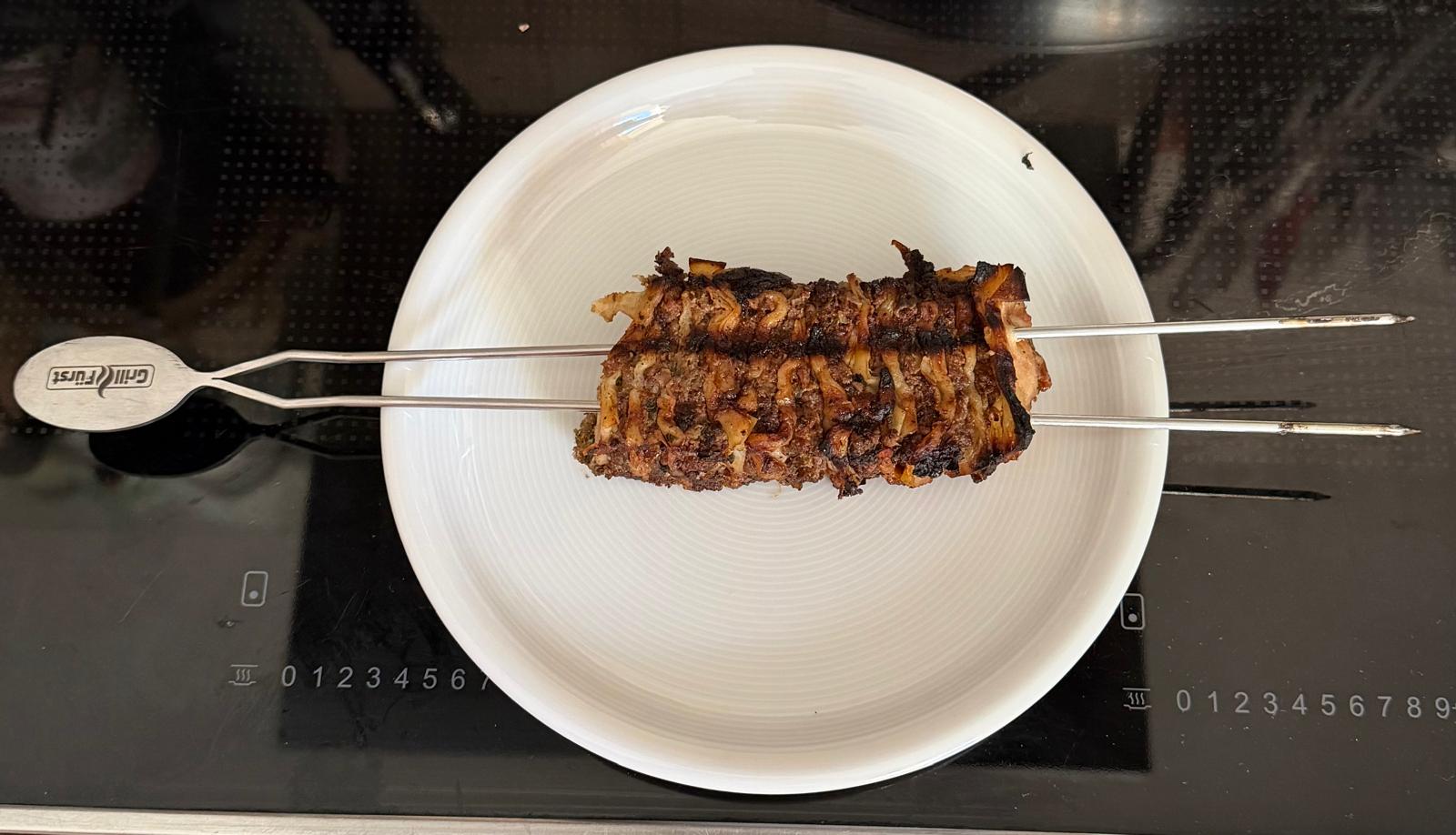
First, there was the tomahawk steak. Four kilograms. When you hold something like this in your hand, you already feel a bit like a king of the barbecue. Then I had three ribeye steaks, cut nicely, clean slices, like you respect the meat. But the real highlight, the thing where everyone later said, “Ralf, what is this?”—that was my experiment.

I found it somewhere on the internet. Sometimes you see something and you think, okay, this looks crazy enough, I have to try it.

Minced meat, good quality, from beef. Then two big onions, really big, chopped fine. Parsley—fresh, of course. Some proper steak spices. Mix it all together with your hands, not with a machine. You must feel it. Cooking is also about feeling, not only recipe.

Then comes the funny part. Tortilla wraps. You layer them—meat, tortilla, meat, tortilla—like building a small tower. Then you take a sharp knife, very sharp, and cut everything into cubes, about one centimeter. After that, you push the cubes onto kebab sticks. But not the simple ones—you need the ones with two spikes, so the meat doesn’t turn when it’s on the grill. Small detail, but very important. Like in life, yes? The small things decide everything.

On the grill, you must watch carefully. The meat has fat, and the fat makes fire. So you turn it, turn it again, move it, stay with it. No phone, no distraction. Just you and the fire.

And then I made a sauce. Butter in a pan, a bit of maple syrup, and some steak spice. When the meat is nearly finished, I brush it over. Then the flames come up—whoosh—and you must be quick, turn it, control it. It’s like dancing with the fire.

When we ate, it was quiet for a moment. That is always the best sign. And then the talking started—“I never tasted something like this.” That makes me happy. Really happy.

Cooking is my second office. Maybe even my real office.

Because the other office… that is something different.

At the moment, I feel like I am working too much. Every time, actually. There is so much work—inside, outside, distributors, reports—and everything must fit into five days. It doesn’t fit. It’s too much Excel, too many reports. Report here, report there, report, report, report.

I am a salesman for outside. I like to drive, to meet people, to talk, to shake hands. Not to sit in the office and write what I already did. Sometimes I ask myself, who reads all this? Maybe someone reads a little bit. Maybe not. I don’t know.

But I have one rule. At five o’clock, I stop.

I close the office door. The phone stays there. The laptop stays there. Finished.

Then I go to the kitchen. Or to the barbecue. That is my other office, yes—but a better one. There I cook for my wife. We drink coffee, we talk. That is life.

Then I go to the kitchen. Or to the barbecue. That is my other office, yes—but a better one. There I cook for my wife. We drink coffee, we talk. That is life.

Of course, the work is still in my head sometimes. Especially when I push things to the next day, and the next day, and the next day. Then in the night, I wake up. Go to the toilet—this is normal when you are over sixty—and then I think. Not always good thoughts. Sometimes I am not so happy. But then I say to myself: “Okay, tomorrow. You do it tomorrow.” And then I can sleep again.

I learned this discipline also from earlier times.

When I was young, I worked as a car electrician. I loved it. Even when it was cold and I had to lie under a truck, it was still… I don’t know… it felt alive. Then the military came. I thought it would be bad. It was not. It was a very good time.

We worked together, lived together. In the evening, someone had a guitar, we had vodka, orange juice, we sang. Sometimes we finished work and said, “Let’s go to the beach.” And we went. Just like this. That was work, but it didn’t feel like work. It felt like life.

Later, I worked many years in an Austrian company. A family company. There, you could feel something—respect for people. Real respect. Not only words on a wall, but something you feel when you walk through the building.

Then one day, someone came and said, “I give you more money.” And I thought, okay, more money is good.

That was a mistake.

A big one.

Because money is not everything. Work-life balance, how people treat each other, how you feel in the company—that is much more important. You only understand this when you lose it.

Now I am in another company, also a family company, but different. More pressure. More “hire and fire.” Less… heart, maybe.

So I try to protect my life where I can.

Even when I travel, I keep my rules. If I have dinner with a distributor, we don’t talk about work all the time. No laptop, no presentations. We eat, we talk about life. Otherwise, next time he will say, “No, sorry, I have no time.”

And if I am alone in a hotel? Same thing. Work stays closed. I take my private phone, my private tablet. I relax.

But if I pass a good butcher on the way—ah, that is different. Then I stop. Always. Life must have priorities.

People sometimes tell me I should write a book. About the best roads, the best butchers, the best breakfasts. Maybe one day. But first, I have another book in my head.

Retirement… I am not afraid of it.

If tomorrow someone says, “Ralf, you are finished,” I say, “Okay.” I have my golf clubs. I have my barbecue. I have plans to build, to cook, to teach maybe other men how to cook. Because many cannot even boil water properly. This is a problem we must solve.

And maybe I make a small restaurant. Not open for everyone. Only for friends. Invitation only. You come, you eat, you enjoy. No stress.

That is, for me, the real balance.

Work is important. Yes. But life is not only reports and Excel. Life is fire, butter, a good piece of meat, a quiet evening, and someone sitting next to you saying, “This tastes fantastic.”

And then you know—you did something right.

Juicy Grilled Skewers – Umami Flavor

Ingredients:

For the glaze:

I remember the first time I saw this recipe, I thought, this cannot be normal. Tortillas, minced Wagyu, cubes on a stick… it sounds a little bit crazy. But sometimes the crazy ideas are the best ones, especially when fire is involved.

So I start simple.

First, I take one kilogram of Wagyu minced beef. Good meat—you see it already with your eyes, you feel it in your hands. Then two big onions, really big ones. I cut them fine, not too rough. A bunch of parsley, fresh, green, smelling like summer. And a bit of confit garlic, soft, deep flavour, not too sharp.

Everything goes into a bowl. I add about one tablespoon of steak seasoning—not too sweet, this is important. Then I mix it with my hands. Not with a spoon. You must feel the texture, how it comes together. That’s the moment where cooking begins, not before.

Then I take the tortillas. Five, six, maybe seven—it depends how hungry we are.

Now comes the fun part.

I lay one tortilla flat. On top, I spread a thin layer of the meat, maybe one centimetre. Then another tortilla. Again meat. Then tortilla again. Like building a small tower. It feels a bit like construction work, and I like that.

When the stack is ready, I take a very sharp knife. This is important. If the knife is not sharp, everything goes wrong.

I cut the whole thing into small cubes. Nice, clean pieces.

Then I take my skewers—but not the cheap ones. I use the ones with two spikes, so the meat does not turn when it’s on the grill. Small detail, big difference.

I push the cubes onto the skewers, one by one. Already here, you can imagine how it will taste.

The grill is hot. Not too aggressive, but ready.

I put the skewers on. And now—you stay there. No phone, no walking away. The fat from the Wagyu will drip, and the flames will come. You must turn them, move them, control the fire. It’s like a conversation between you and the grill.

While this is happening, I prepare the glaze.

Half a pack of butter goes into a pan. It melts slowly. Then I add two tablespoons of maple syrup. Sweet, but not too much. And a bit of the same seasoning again. It smells already incredible.

When the skewers are nearly finished, I take a brush and paint the glaze over the meat.

Then—whoosh—the flames come up. You turn, quickly, carefully. Again and again. This is the moment where everything comes together.

When it’s done, you take them off the grill. Maybe you let them rest a minute. Maybe you don’t. Sometimes patience is good, sometimes hunger wins.

And then you eat.

The outside is a little bit crispy, the inside is juicy, soft, full of flavour. The tortillas hold everything together. The glaze gives this sweet, smoky finish.

And when your friends are quiet for a few seconds after the first bite, you know—you did it right.

source
The Pineapple

Between Duty and Desire: Three Lives, One Question About Work

It began, as these conversations often do, with a small correction that carried more weight than it seemed.

“Not a little bit older,” Ismar said, almost gently, but with that quiet insistence that comes from a lifetime of precision. “Double.”

The Mayor had smiled, trying to soften the gap with politeness. But the gap remained. Thirty and sixty-five. Bengaluru and Campo Grande. A man still building his life, and another looking back at the structures that had built his.

And somewhere between them sat the question: What is work, really—and what has it taken from us?

From the outside, it could have sounded like a simple discussion about work-life balance. A modern phrase, almost fashionable. But as the conversation unfolded, it became clear that the phrase itself belonged more to Ritesh’s world than to Ismar’s.

For Ismar, the idea of “balance” had never really existed as a concept.

Most people he had known, he said, did not speak about life outside work at all. Whether in public service or private companies, conversations circled back again and again to the same thing: the job. Problems at work. Tasks completed. Issues unresolved.

It puzzled him.

“I don’t know why,” he said, with that familiar hesitation. “I don’t know if people don’t have other interests… or if they don’t read… or don’t watch anything.”

He gave an example—his former brother-in-law, a man who had spent decades in a semi-public water company, climbing almost to the top. A stable career, a respectable position. But when he spoke, it was always about work. Only work. Even when meeting family, even when time allowed for something else.

No hobbies. No stories beyond the office.

It wasn’t said with judgment. Just observation. That was his way—looking at life almost like a case study, trying to understand patterns without forcing conclusions.

Ritesh listened carefully. You could see, even in silence, that he was placing this somewhere inside his own framework—comparing, contrasting, trying to find the “two sides” of it.

Because in his world, work was not just something people talked about. It was something that consumed.

If Ismar’s generation had accepted work as “this is normal, don’t question it,” Ritesh’s generation had started to question—but without the power to change.

“Most of the energy goes to work,” he said, almost matter-of-factly.

Not just work itself, but everything around it. The commute. Forty-five minutes each way. It sounds small, he admitted, but it drains something invisible. If his house were closer, he said, he could save two hours a day. Two hours of life, quietly absorbed into the system.

Not just work itself, but everything around it. The commute. Forty-five minutes each way. It sounds small, he admitted, but it drains something invisible. If his house were closer, he said, he could save two hours a day.

And then there was the other layer—not time, but expectation.

In theory, work-life balance was something everyone wanted. Especially people with families. In reality, it was something you negotiated carefully, almost fearfully.

“You cannot say no,” he explained.

Not because the rulebook forbids it, but because the consequences are understood without being spoken. Replacement is always a possibility. There is always someone else.

So people carry laptops on holiday. Answer calls at night. Join meetings that stretch across time zones. A colleague responding at 10:30 p.m. is not seen as extreme—it is seen as responsible.

And sometimes even as admirable.

There was something subtle in the way Ritesh said this. Not anger, not even complaint. More like recognition. This is the system. This is how it works.

But he also saw the contradiction clearly.

“There is a culture,” he said, “and there is a wish.”

The wish is for balance. The culture is something else entirely.

Listening to both of them, the difference was not just generational. It was structural.

For Ismar, work had been something imposed but stable. It shaped him, yes—he admitted that openly. The military environment had influenced his personality, even his sense of authority.

“I think I am a little authoritarian,” he said, almost apologetically.

But he had also resisted. He had chosen, consciously, not to carry certain behaviors home. The harsh language, the rigid tone—those stayed at work, as much as possible.

He had tried to separate worlds.

Not always successfully. That, too, he admitted.

Because work does something deeper than schedule. It shapes how you think, how you respond, how you see others. And in environments like the military, where hierarchy is absolute, that influence is difficult to escape.

There were moments of quiet injustice that had stayed with him.

Being forced to remain at work even after finishing tasks. Two hours of unnecessary waiting, simply because a superior said so. The logic did not matter. Authority did.

He had even risked punishment by leaving early once. Expected jail. It did not come—but the memory remained.

And then there was the larger unfairness. Opportunities given not by merit, but by connections. Exams passed, but promotions denied. Others, less qualified, moving ahead because they had support from above.

“Military environment is not a fair place,” he said simply.

And yet, in the same breath, he spoke of pride.

Because his work—aviation management—had meaning. Planes carrying food across the country. Systems that allowed people to live better. He could see the impact.

So again, two sides.

Pride and frustration. Stability and injustice. Duty and limitation.

Ritesh recognized this pattern instinctively.

His own experience was different in form, but similar in structure.

Hierarchy, he said, is deeply embedded in Indian culture. Not just in work, but everywhere—family, education, society. Respect is important, but it often becomes silence.

You don’t question. You comply.

And in corporate life, that translates into something very specific: availability.

Your time is not entirely yours.

Even when you are off, you are not completely off.

He described how work schedules are shaped not by personal boundaries, but by global dependencies. Meetings across time zones. Clients in different countries. Teams working in overlapping hours.

“It’s not that work moves on my time,” he said. “I move on others’ time.”

That one sentence seemed to land heavily in the space between them.

Because it captured something both men understood—just from different angles.

The Mayor, observing quietly, tried to push the comparison further.

What about Europe, he asked, where in some countries it is forbidden for a boss to contact employees outside working hours?

Ritesh smiled slightly.

“It is like a dream,” he said.

Not impossible. Just distant. Something you see in videos, in stories, in other systems. But not something that fits easily into the current reality.

Because here, the structure is different.

There are fewer protections. Weaker unions. Stronger dependence on employers. A larger population competing for the same opportunities.

And so, the pressure becomes internalized.

People don’t just comply—they begin to believe in the system. They find identity in being needed, in being available, in being the one who responds.

Even when it costs them something.

And then the conversation moved, almost naturally, into the most fragile space: relationships.

What happens when work consumes this much energy?

What happens to a marriage?

Ritesh spoke carefully here. Not theoretically, but through examples.

A colleague who could not sustain basic communication with his wife’s family. Not because of lack of intention, but because of exhaustion. Frustration. Disconnection.

Eventually, divorce.

There was no dramatic blame in the story. Just a quiet breakdown.

Because time is not just about hours—it is about attention. And attention, in these systems, is already spent elsewhere.

Even in his own life, Ritesh was navigating this balance consciously. His wife considering work, preparing for it, but also aware of the complexity. The trade-offs.

He did not impose. That was important to him.

“If you want to work, it is fine,” he said. “No issues.”

That sentence carried something deeper than it seemed. A conscious effort not to repeat the same structures of control he himself had experienced.

Respect, without dominance.

Support, without expectation.

Again, two sides—tradition and change, coexisting uneasily.

In the end, there was no conclusion. No neat answer.

Only a shared recognition.

Ismar, looking back, saw a life shaped by work—sometimes meaningfully, sometimes unfairly. He accepted its influence, even its flaws, with a kind of quiet realism. He had done what he could within the system he had.

Ritesh, looking forward, saw a different kind of challenge. Awareness without power. Desire for balance without structural support. A generation trying to redefine work, but still caught inside its demands.

Between them sat the Mayor, bridging worlds, asking questions that revealed more than they resolved.

Three men. Two generations. Three continents.

And one shared understanding, perhaps unspoken but present:

Work is never just work.

It is culture. It is power. It is identity.

And somewhere, always, it is also a negotiation—with time, with self, and with the lives we are trying to build beyond it.

source

I still remember how quiet it felt on that first day.

Not quiet in the sense of silence—there were machines, people, movement—but inside me, it was quiet. I didn’t know what to think yet. Everything was new, and at the same time, nothing felt special. It wasn’t a big moment like you imagine when you’re younger. No music, no excitement. Just a normal morning where I showed up, and work started.

Looking back, that’s probably what made it real.

I was seventeen when I started. At that time, I didn’t like school. Sitting, listening, writing—it never felt like my world. I always preferred doing something with my hands, creating something, seeing a result at the end. So when I entered this small company—maybe 25 people—it felt like I was finally in the right place.

But the beginning was not what I expected.

In the first week, they didn’t give me a real job. I just moved from one workplace to another, watching people. Eight hours a day, standing next to machines, observing. It sounds easy, but it wasn’t. It was boring in a way that makes time feel heavy. You look at the clock, and it feels like it doesn’t move.

And then the real work started.

My first task was simple on paper: filing metal pieces. Taking a raw component and shaping it to the exact length and width. Over and over again. The same movement, the same focus, the same resistance in your arms.

I think that first piece had around twenty components. And I worked on them for two months.

Two months.

At the time, it felt endless. But today, I understand what it really was. It wasn’t about the metal. It was about patience. About discipline. About learning to stay focused even when nothing is exciting.

At the time, it felt endless. But today, I understand what it really was. It wasn’t about the metal. It was about patience. About discipline. About learning to stay focused even when nothing is exciting.

And then came the cube.

They told me to file a perfect cube. Sounds simple. But it wasn’t. Every angle had to be exact. Ninety degrees. Every side the same length. No machine. Just your hands, your eyes, and your concentration.

That job broke many people.

Most apprentices quit in the first three months. I understood why. It wasn’t physically impossible—it was mentally exhausting. You had to give 100% attention all the time. One small mistake, and the whole piece was wrong.

But I stayed.

At that time, I didn’t think in big words like “resilience.” I just did the work. But now I see it differently. The company was testing you. Not your talent—your mindset.

Can you continue when it’s boring?
Can you focus when nothing is exciting?
Can you finish something that feels pointless in the moment?

That’s what they wanted to know.

And it didn’t stop there.

Every evening, after the real work was done, I had to clean. Not just my workplace—the whole factory. My best friend was a broom. One hour, every day, sweeping the floor.

And my boss… he saw everything.

He was a perfectionist. If I missed even a small spot, he would find it. Every time. “Alex, you forgot this place.” And then I had to do it again.

At that time, it was frustrating. I thought he was too strict. Too focused on small things.

Now I see it differently.

He was teaching me that details matter. That “good enough” is not enough. That if you do something, you do it properly.

But not everything was serious.

There was also the other side—the people.

I was the young one, the new one. And of course, I became the target of jokes. One time, an older apprentice told me to use a special paste on my file. He said it would make the work easier.

I believed him.

After I applied it, my tool was basically destroyed. I couldn’t work anymore. And everyone was laughing.

In that moment, I felt stupid. But I also learned something: not everything people tell you is true. And sometimes, you have to learn the hard way.

Later, when I was one of the older apprentices, I did the same.

We built a “special broom” with a cable and told a new guy it was an ultrasonic device. If it made a sound, he had to report it to the boss immediately.

Of course, I stood behind him, made a noise with my phone, and he ran to the boss in panic.

Even the boss laughed.

It sounds childish, maybe. But these moments created connection. You were not just working—you were part of something.

Still, not all relationships were easy.

There was one colleague who trained me on a machine. Very strict. For him, everything I did was wrong. Every mistake was pointed out. Every detail criticized.

At that time, I thought he just wanted to annoy me. I couldn’t see anything else.

Now, I understand it differently.

He wanted to teach me properly. He wanted to make sure I didn’t develop bad habits. His way was hard, but his intention was not negative.

That’s something I only understood years later.

But the most important lessons didn’t come from instructions. They came from situations.

I remember when I started working with new machines. Faster, more efficient. I could produce a piece in one day that used to take a week.

That sounds like success.

But it created a problem.

After my process, the piece went to an older colleague. He had to finish it by hand. And because I was faster, he had more pressure.

He didn’t like that.

He started going to the boss, saying my work was not good. He made things difficult for me. Every day, small tensions.

That was the first time I really understood something about people.

It’s not always about right or wrong. Sometimes it’s about feeling. About pressure. About fear.

And leadership matters.

My boss only saw it when I decided to leave. He asked me why. I told him. Then he said, “I didn’t know.”

Maybe he should have seen it earlier.

That moment stayed with me.

Because it showed me how important it is to pay attention. Not just to results—but to people.

And then there were the moments that felt… different.

The first time someone trusted me with a real task.

Not just training. Not just small jobs. A real responsibility.

It didn’t come all at once. It grew step by step. Small tasks first, then bigger ones. Until one day, I had something important.

I remember one situation very clearly.

I had to finish a large workpiece in one day. It had to go to another company the next morning. No delay possible.

I started at 7:30 in the morning.

I finished at 11:30 at night.

Long day. Very long day.

But I finished it.

And the next morning, I called my boss and said, “The piece is done. Can I take a day off?”

He said yes.

That felt good.

Not just because of the free day. But because I knew: I delivered. I was reliable. They could trust me.

That feeling stays with you.

And then, of course, there was the first salary.

€450.

At that moment, I thought, “Now I’m rich. I can buy everything.”

Two weeks later, my account was empty.

Reality teaches fast.

Later, when I earned €1,500, I had the same feeling again. And the same realization.

But that’s also part of growing up. Understanding value. Responsibility. Managing your life.

When I look back now, after all these years, I don’t think about the machines first. Or the technical skills.

I think about the mindset.

Showing up every day.
Doing the work properly.
Paying attention to details.
Understanding people.
Staying calm when things are difficult.

And one thing more.

You have to enjoy what you do.

Because if you don’t, every day feels heavy. But if you do—even hard work feels different. It becomes part of your life, not something you want to escape from.

If I could speak to my younger self on that first day, I wouldn’t give him a big speech.

I would just say:

“Give your best. Every day. Even when it’s boring. Even when it’s hard. Especially then.”

Because in the moment, it doesn’t feel important.

But later, you realize—it was shaping everything.

source

She remembers the journey first as a feeling in her body, not as a sequence of events. Sitting still for too long, the weight of waiting, that slight restlessness that comes when nothing is moving but time.

It had started early, somewhere between one train and the next, crossing through Germany toward Belgium. At first it was simple enough — just connections, platforms, watching the clock. And then everything slowed down without warning. In Brussels, they didn’t let anyone leave the train. There had been a bomb alarm in the underground. Three pieces of luggage, someone said. One of them with a phone and cables. Suspicious enough to stop everything.

So she sat. Three hours, maybe more. Not doing anything, just waiting, surrounded by other people doing the same. The kind of waiting where you don’t really know what you’re waiting for. By the time she reached the hotel it was already late, around ten at night, and the day felt longer than it should have been for such a short distance .

What stayed with her wasn’t fear exactly, just a quiet discomfort. The sense of being held in place.

Meeting her colleagues the next day felt like stepping into something entirely different. Faces she had only known through screens suddenly became real, close, speaking directly to her. That part made her nervous. Standing in front of people, speaking in English, trying to present herself — it never felt natural to her. She could feel it in her chest, that slight tightening, the awareness of every word.

But it passed. Not perfectly, not comfortably, but it worked.

There were training sessions too. Exercises where she had to speak again, share ideas, give opinions. She did it because it was expected, because everyone else was doing the same. And then, in the evening, there was dinner, voices softer, the tension easing a little with food and conversation.

The next day felt lighter. Walking through the production spaces, talking to people, having time to observe rather than perform. And then the chocolate museum.

She remembers that part almost with a kind of quiet amusement. The way everything was explained so simply, from the cacao tree to the finished product. The small devices they carried, each in their own language, listening as they moved from one section to the next. It was easy to follow, almost playful.

The small devices they carried, each in their own language, listening as they moved from one section to the next.

And then the tasting.

She tried everything — from the soft, sweet white chocolate to the darker, heavier kinds. Too many, probably. She went through them more than once, almost without thinking, just because they were there. By the end of the day, even the meals had chocolate in them — in the starter, in the main dish. It became a bit too much, but she kept eating anyway.

She always does that. She enjoys it in the moment, and only later, quietly, she regrets it a little .

There was something nice about making the chocolates herself, shaping them with her hands, knowing she would take them home. It felt simple, almost childlike.

Still, her body noticed everything. The sitting, especially. Too many hours without moving. By the time she got back, she needed to run, just to feel herself again. Not far, not fast — just enough to undo the stillness.

After that, her thoughts shifted forward, to the next trip already waiting. Egypt. The idea of it felt different. Not the same kind of structured, planned days. More uncertainty. There were small concerns — fuel shortages, the possibility of not being able to return on time. Practical worries, not dramatic ones. She found herself thinking about backup plans, about whether she should take her laptop, just in case.

But at the same time, she knew she shouldn’t. A holiday should be a holiday.

There is always that balance in her life — between doing what is necessary and allowing herself to rest. Between planning and letting things be.

What stayed with her most from that period wasn’t just the travel itself, but the contrast. Moving between countries, languages, ways of living. Talking to someone from South Africa about how many languages exist there, how English becomes the common ground between people who otherwise wouldn’t understand each other. Hearing about histories that feel distant, yet still present in small ways.

She didn’t try to analyse it. She just listened, noticing how different things could be, and how normal they felt to the people living inside them.

Work, in its own way, had become something similar. A network of places and voices — Germany, France, Belgium, the UK — all connected through emails, calls, small daily exchanges. That part she genuinely liked. The feeling of being in contact with many places at once, without moving.

Even the small mistakes stayed with her. Sending a personal document to the wrong person once, feeling that sudden rush of panic, trying to recall the message too late. It embarrassed her, but also taught her something practical. Now she knows how to react faster. It becomes just another small memory, not something to hold onto for too long.

And then everything settles again into something familiar. Thoughts of Easter. Family. Food.

She pictures the table already — too much food, always too much. The long time spent before the meal even begins, the aperitif stretching on while someone quietly complains about being hungry. Everyone bringing something, everyone contributing in their own way. Cooking together, moving around each other in the kitchen.

She doesn’t overstate it. It’s just nice.

There will be laughter, small conversations, children somewhere in the background, and the quiet rhythm of people who know each other well. Not perfect, not extraordinary. Just shared time.

And maybe that’s what stays with her the most. Not the delays, not the presentations, not even the travel itself — but those small, ordinary moments where nothing needs to be explained.

She doesn’t try to make more of it than that.

Partner Page
Advertisement
source
The Pineapple

Humanizing Mistakes: A Lesson in Funny Fails

In a world that often celebrates perfection, the smallest mistake can feel far bigger than it really is. A slip of the tongue in class, a fall in front of classmates, or a message sent to the wrong person can seem disastrous in the moment. Yet in a warm and thoughtful lesson between Fruitloop and Sarah these awkward moments are transformed into something far more meaningful: reminders that mistakes are part of being human.

The conversation begins lightly, with Sarah describing school as “really cool” because she only had one easy exam that day. From there, Fruitloop introduces the topic of “funny work fails,” explaining that these are the kinds of harmless mistakes that might first bring embarrassment, but later become stories people laugh about together. Rather than treating failure as something shameful, the discussion presents it as a normal and even valuable part of life.

Sarah quickly proves she has no shortage of stories. She recalls accidentally calling a female teacher “mother” instead of “mister,” a mistake that instantly turned into a funny classroom moment. She also remembers tumbling down a large staircase in front of the whole school during break time. At the time, it was humiliating. Later, it became one of those memories that survives not as pain, but as comedy. The embarrassment faded, but the story remained.

Another memorable fail came through technology. Sarah describes sending a tired, emotional video message to the wrong people on Snapchat, including people she barely knew. It was the kind of mistake that feels unbearable for a few minutes, especially in a teenage social world where image matters so much. Yet even this became part of the lesson: one small error does not define a person. It simply becomes another example of how easy it is to be imperfect.

Perhaps one of the most charming stories is Sarah’s account of trying to be kind. In primary school, she attempted to open a door for a teacher, only for the handle to come off in her hand. Instead of looking careless, she came across as sincerely unlucky. That moment captures the heart of the lesson: sometimes mistakes happen not because we are reckless, but because life is unpredictable. Even good intentions can end in disaster—and that is exactly why these moments are so relatable.

In primary school, she attempted to open a door for a teacher, only for the handle to come off in her hand.

Fruitloop introduces one of the lesson’s most important ideas: the “seriousness filter.” This is the ability to pause and judge whether a mistake is genuinely dangerous or simply awkward and funny. If someone is hurt, the reaction should be care and concern. If no one is harmed, laughter can be healing. This simple idea helps reframe failure. Instead of turning every mistake into a crisis, the seriousness filter encourages perspective. It asks people to separate real danger from ordinary human clumsiness.

What makes the discussion especially thoughtful is that it does not suggest laughing at everything blindly. Sarah wisely points out that some people are more sensitive than others. A moment that seems funny to one person might feel devastating to another, especially if they are shy or already embarrassed. In her dance class, she has seen how small mistakes can reduce someone to tears. For her, the response should depend not only on what happened, but on how the person feels. In this way, the lesson becomes not just about humor, but about empathy.

The pair also explore how these failures can actually build trust. When people share stories of awkward moments, they reveal vulnerability. They show that they are not polished all the time, not always graceful, not always in control. That honesty can make friendships and classrooms feel safer. Instead of pretending to be flawless, people can admit they are still learning. Sarah’s stories do exactly that. They make her relatable, funny, and real.

At the same time, Fruitloop is careful to draw a boundary. A funny fail should stay funny; it should not become cruelty. Laughing once is different from turning someone’s mistake into a nickname, a repeated joke, or a form of bullying. Sarah understands this distinction clearly. She explains that with close friends, shared memories can become harmless jokes or references, but with others, repeating the story too often can cross the line into unkindness. The lesson is not about mocking people—it is about creating an environment where mistakes are allowed without lasting humiliation.

As the conversation continues, the tone becomes playful. Fruitloop asks Sarah imaginative questions: what would the seriousness filter look like if it were an object, what food would relief after embarrassment taste like, and what kind of trophy should be given for the funniest fail of the year. Sarah’s answers are creative and quirky, comparing the seriousness filter to the clock from Beauty and the Beast, imagining a spoon-shaped trophy with tea, and describing mistakes as having the sweet smell of a toffee apple—unless it is a bad mistake, in which case the apple has gone rotten. These questions turn the lesson into more than language practice. They invite Sarah to think emotionally, visually, and humorously about failure itself.

By the end of the session, one message stands out clearly: mistakes are inevitable, but they do not have to be destructive. When handled with perspective, kindness, and a little humor, they can become some of the most memorable and human parts of everyday life. For Sarah, each blunder carries both embarrassment and possibility. For Fruitloop, each fail is a chance to teach resilience. Together, they show that funny failures are not interruptions to learning—they are part of learning.

In the end, the lesson is not really about falling down stairs, breaking door handles, or saying the wrong word. It is about how we respond when life makes us look silly. We can panic, hide, and replay the moment forever—or we can breathe, apply the seriousness filter, and let the moment become a story. In that choice lies something powerful: the ability to turn failure into connection, and embarrassment into laughter.

source
The Pineapple

The “Be Prepared” Paradox

There is a specific kind of magic in the words “school holidays.” For a mom, they sound like a long, cool drink of water after a marathon.

In my mind, the script is already written: I am sleeping in. The house is silent. I am cradling a warm cup of Jo in the soft morning light while my son is still peacefully snoozing away. There is no shivering in the dark, no racing the clock, and no “lateness-meter” ticking in the back of my brain. It’s the ultimate reset button.

But then, reality walks into the room, and the script gets a rewrite.

I am a person who functions on rules. I like schedules. I like keeping time. I write everything down, making little notes and tracking the day like a scout on a mission. Usually, this happens in the quiet gap after school drop-off, a moment of alignment before the world starts spinning.

But school holidays are my nightmare dressed as a daydream.

Without the school bell to anchor me, I lose track of time and responsibility. It’s a silent chaos brewing in the distance, like a storm rising over the horizon. By Monday, I had effectively disappeared off the planet. I was so busy tackling tasks around the house that by the time I sat down to work, the brain fog had moved in.

Then came the dreaded words: “I’m hungry.”

For the third time that day. I nearly lost it. Needless to say, the “work” part of my day remained a very pretty, untouched plan on a piece of paper.

Tuesday was the tipping point. For reasons unknown to science or technology, my alarm clock simply didn’t go off.

I woke up in a daze, convinced my meeting was at 10:00 AM. I was wrong. It was at 9:00 AM. I had officially overslept, missed the call, and completely ruined the Mayor’s well-planned day.

There’s a song in The Lion King where Scar sings to the hyenas, “Be prepared.” Sitting there in the aftermath of a missed morning, those words felt like a personal call to action. I realized that while I love the idea of a break, a break without a plan is just a recipe for a mess.

So, on Wednesday, I channeled my inner Scar. I checked my alarm three times. I woke up early, did the laundry and tidied up the house a little—even though I knew it was a lost cause. My son can destroy a room in two seconds flat with a calculated explosion of toys, books, coloring pencils, and Legos. I have stepped on more plastic bricks in the last four days than I care to admit.

But Wednesday worked. I planned the day, got the meeting times in place and correct this time round. I didn’t miss a single thing and it turned out to be one of the most productive days I’ve had since last Friday.

I sat in my office and realized that Tuesday was just a gentle, slightly loud reminder that we are only human. We run around, we get things done, we miss things, and then we spend the rest of the week catching up.

The world didn’t come to an end because I slept through a meeting. But I also realized that I should probably be more prepared and follow some of my own advice. Being a “unicorn” doesn’t mean you don’t need a map; it just means you look better while you’re following it.

I would much rather be waking up to the view of a beach and the waves crashing into the rocks. Or sitting outside in the Kruger National Park listening to the birds in the morning or the lions and hyenas at night.

But here I am, being the perfect chaos coordinator at home, fixing things that aren’t really broken and herding the digital lions of my daily life.

We are halfway through this short April break. Eleven days of pure bliss, or at least, eleven days of trying to find the balance between the holiday spirit and the “Be Prepared” discipline. Things change, alarms fail, and sometimes you just need to sleep through the first act to get the second one right.

I’ll check the alarm three times again, just to be sure.

Tomorrow is a busy day full of meetings, which I cannot miss. My son will be driving grandma crazy for day, and I can work in peace. Friday will be my “duvet day”. As for the rest of the weekend – it’s still unknown and unplanned.

source
The Pineapple

The Ferrari Meeting & the Shape of a Dream Job

The morning started quietly, almost too quietly for what Maxime was about to reveal. Fruitloop leaned forward with curiosity, asking the question that had been waiting all week: “How was the Ferrari dinner?”

Maxime smiled, the kind of smile that already gives away the answer. It wasn’t just good—it was unforgettable.

He described the moment they arrived. Not just people stepping out of a car, but Ferrari representatives arriving in style, with a machine worth nearly half a million euros. It wasn’t subtle, and it wasn’t meant to be. Standing there were three figures from the world Maxime dreams about: a human resources director, an engineer from the Formula 1 academy, and a marketing director. For a moment, school didn’t feel like school anymore—it felt like the edge of something much bigger.

They spent the day together, walking through the campus, sharing a meal, talking about studies, careers, and what it takes to enter the world of Formula 1. Maxime listened closely, absorbing every detail. And then came the words that mattered most: their profiles—his profile—was exactly what Ferrari was looking for.

But dreams, as he quickly learned, come with timing.

He wasn’t there yet.

Ferrari wanted graduates, students ready to step into six-month internships that could turn into long-term contracts. Maxime was still early in his journey. Still learning. Still building. But instead of closing the door, they did something unexpected—they gave him a path. He could send his CV. They gave him contacts at Cranfield University. They showed him what the next two years could look like.

For the first time, the dream wasn’t distant anymore. It had steps.

Later, as the conversation shifted, Maxime mentioned something more personal—his motorcycle. He would have to sell it soon. There was no drama in his voice, just a quiet disappointment. He only had a few days left to enjoy it, and even the weather seemed against him. Sunny days would come… just after it was gone.

It was a small detail, but it carried weight. Moving forward sometimes means letting go of the things that made the journey enjoyable in the first place. Still, he found a way to soften the loss—his father’s bike would be waiting. Not the same, but enough.

As if balancing Ferrari and personal sacrifices wasn’t enough, gymnastics remained a constant challenge in the background. Maxime had just completed his national qualification, pushing through pain in his ankle and adapting his routines to stay competitive. The level this year was higher than ever—elite athletes, Olympic hopefuls, all competing in the same category.

As if balancing Ferrari and personal sacrifices wasn’t enough, gymnastics remained a constant challenge in the background.

And yet, he stood his ground.

Seventeen places open for now. Not perfect, but promising. Quiet confidence replaced celebration. He knew he had done enough—now it was just a matter of waiting.

Fruitloop listened carefully, then gently steered the conversation in a new direction.

“What is your dream job?”

It sounded like a simple question, but Maxime didn’t answer it simply. He didn’t name a role or a company. Instead, he described a feeling—a kind of life where work doesn’t feel like work at all.

A job where you wake up and want to go.
A job where time doesn’t drag.
A job that leaves space for life, not just effort.

Money mattered, of course—but not more than enjoyment. Because, as he put it, you can’t spend years doing something you don’t enjoy, no matter how well it pays.

Fruitloop introduced an idea to help shape that vision: a dream job lives at the intersection of what you love, what you’re good at, what the world needs, and what you can be paid for. Maxime listened, recognizing pieces of himself in each part. He wasn’t there yet—but he was moving toward it.

When asked about his strengths, he didn’t talk about medals or rankings. Instead, he spoke about something quieter—coding, building, experimenting on his laptop late at night.

He liked creating things.
He liked solving problems.
He liked not knowing—and figuring it out anyway.

That curiosity, more than anything else, seemed to define him.

Then, unexpectedly, the conversation expanded beyond careers. Maxime began questioning the system itself—the idea that life is structured around work from the moment you’re born. He spoke about freedom, about how people long ago lived differently, hunting, gathering, surviving without the systems we now take for granted.

It wasn’t rebellion—it was reflection. A young engineer trying not just to enter the world, but to understand it.

Fruitloop responded with perspective, explaining how economies evolved, how trade became currency, how complexity made structure necessary. Somewhere between the two viewpoints, something balanced emerged—not agreement, but understanding.

To lighten the mood, Fruitloop introduced a playful idea: a magical portal.

“If your dream job was a portal,” she asked, “what would happen when you stepped through it?”

Maxime didn’t choose shortcuts. He didn’t wish for success without effort. Instead, he imagined something far more interesting—the portal would give him ideas. Better solutions. The ability to design the best car, to think faster, to innovate.

Even in imagination, he chose growth over ease.

And just when the conversation couldn’t get more unexpected, it did.

“Would you still choose your dream job if you had to wear a chicken costume every day?”

Maxime paused, genuinely considering it.

Then, with a grin: “Why not?”

Because in the end, maybe the details don’t matter as much as the direction.

As the session came to a close, plans were made—another meeting, more discussions, a future gap year to explore. Nothing was fully decided yet, but everything was moving forward.

Maxime wasn’t at Ferrari.
Not yet.

But he had something just as powerful:

A clear path.
A growing skill set.
And a dream that was no longer just a dream—it was becoming a plan. 🏎️

source
The Pineapple

Martin and the Perfect Car That Probably Shouldn’t Exist

Dream jobs are usually sold to us as destinations. Clean, structured, achievable with the right mix of ambition and Wi-Fi.

Martin’s dream job doesn’t behave like that.

It wanders. It contradicts itself. It sits on a park bench and refuses to be rushed.

And somehow, it still makes perfect sense.

When Martin was younger, he wanted to design cars. Not in the abstract, but properly—sketches, ideas, shapes that felt like they belonged on the road. He was serious enough about it to actually draw them. Serious enough to still remember them.

They exist somewhere, apparently. Hidden. Lost. Possibly for the best.

There’s no dramatic failure in his story. No single moment where the dream collapsed. Just a quiet shift. He left school early. Life adjusted the trajectory. The world didn’t make space for “car designer,” so something else moved in.

But here’s the thing: the dream never left.

It just stopped asking for attention.

Ask Martin what he would do today—if money, training, and reality politely stepped aside—and he doesn’t say “engineer” or “head of design.”

He says he’d become a professional spectator.

Specifically for his favourite band, Garbage.

“A Garbage Collector,” he adds, with the kind of logic that doesn’t need approval.

This is where Pineapple logic kicks in: the dream job is not about status. It’s about proximity to what you love. Even if your role in that world is simply… being there.

Watching. Listening. Absorbing.

Because Martin doesn’t just like music. He likes talking about it.

Breaking it down. Circling it. Sharing opinions that may or may not have been requested.

There’s a version of his life where this becomes a job title. “Critic.” “Writer.” “Voice of a generation,” if you’re feeling generous.

But in Martin’s version, it’s simpler than that.

It’s just something he does anyway.

Now imagine his perfect Tuesday.

Not a rebranded Monday. Not productivity disguised as passion.

A park bench.

A sketchbook.

And cars—his cars—coming to life instantly. No delays, no revisions, no committees. Just perfect designs materialising into the real world, driven by fans who wave as they pass.

It’s important that they wave.

Recognition matters. But only briefly.

Because even in this fantasy, Martin is already bored of the praise from senior management.

Perfection, it turns out, gets repetitive.

That’s the quiet honesty running through his answers: even the dream has friction.

Even the ideal job contains moments you tolerate rather than love.

And maybe that’s the difference between a fantasy and a usable dream—the ability to see both sides and still want it.

In real life, Martin works in software testing.

It’s not a park bench. It’s not instant car creation. But it isn’t empty either.

There are moments—small, precise, easy to miss—where things click. A proof of concept works. A solution holds. A colleague (Manfred, specifically) delivers a “perfekt script,” and Martin is genuinely pleased.

It’s not the dream job.

But it contains fragments of it.

Creativity. Curiosity. A sense that something invisible has just been made visible.

Then there’s his most underused skill.

Martin describes himself as a “born creator of chaos.”

Which sounds like a problem until you realise it’s actually a form of energy. The ability to disrupt, to shift things, to introduce movement where everything has gone a bit too still.

Not everyone appreciates this.

He seems aware of that.

Still, it feels like the kind of trait that belongs in a dream job—even if the current world doesn’t quite know what to do with it.

If Martin could fix one thing in the world, it wouldn’t be abstract.

It would be ugly cars.

Especially the ones with dark tinted rear windows.

This is not a global priority. It’s a personal irritation. Which is exactly why it matters.

Dream jobs aren’t built on what’s important to everyone.

They’re built on what quietly annoys you enough to care.

And when it comes down to it, Martin doesn’t believe you have to love the job itself.

You have to love the life around it.

Because the job, in his world, is just a support structure.

The real work—the important work—is still ahead:

Designing the ultimate perfect car.

So what’s his next step?

Something small. Realistic. Sensible.

He suggests quitting his job entirely. Forcing the dream into existence. Immediately.

It’s not advice. It’s a pressure point.

A reminder that the distance between “someday” and “now” is often just one uncomfortable decision.

Martin hasn’t built his dream job.

Not yet.

But he’s also never fully let it go.

And maybe that’s the most Pineapple thing about it:

The dream doesn’t disappear.

It just waits—slightly amused, slightly impatient—for you to take it seriously.

source
The Pineapple

The Pursuit of the Dream Job

An opening in four languages and one friendly warning

It started the way “Lunch” conversations often do: not with a thesis, but with a vibe. Rosii warmed up the room by hopping across greetings—Portuguese, English, Spanish, and Japanese—like someone flipping through postcards from past lives. That multilingual playfulness wasn’t just small talk; it was a quiet announcement of who she is: a people-person shaped by real conversations, real customers, and real cultural overlaps.

Enter the Mayor (Frank), who instantly did what a good host does: set the tone and set the boundary—“choose your words with care”—half tease, half gentle steering wheel. The message was clear: we’re here to wander, but we’ll wander together.

And then, like any good origin story, Rosii dropped a character from her past: an older Japanese customer who didn’t just buy tickets—he brought a small trilingual book and turned the travel agency counter into a tiny language classroom. In Rosii’s telling, the memory stays vivid because it wasn’t transactional; it was affectionate, human, and oddly instructional.

From tickets and terminals to a changing definition of “dream”

When the official topic finally arrived—dream jobs—the conversation didn’t snap into a neat motivational poster. It unfolded like a real résumé does: sideways, with detours and surprises. The Mayor asked the straight question (“do you have a dream job?”), and Rosii answered honestly in motion: once upon a time, she wanted to be a tourist guide—and that desire made sense, because tourism wasn’t a chapter for her; it was 24 years.

She walked them through the early timeline: first a real estate rental setting, then a travel agency in Guarulhos, Brazil, where she learned not just routes and fares, but patience—how to handle the public, how to deal with the daily friction that comes with being the person other people need.

The scene turned cinematic when Rosii described work travel sent by her boss every few months—quick trips to learn destinations so she could “sell” them with credibility later. And of course, “Lunch” being “Lunch,” the destination name became a comedy sketch: Jericoacoara—an apparently gorgeous place, and also (in Frank’s imagination) “a duck giving birth to an egg.”

But the real pivot wasn’t the beaches. It was the shift in Rosii’s use of the word “dream.” Her dream job wasn’t frozen in time. “Nowadays,” she said, the dream has moved—toward teaching children.

The dream job isn’t just passion: it’s reward, conditions, and the age of the students

Fruitloop (Janita) did what she does best: she took the emotional concept (“dream job”) and asked for the missing variables—passion and reward. Not just “what you love,” but what sustains you: time off, salary, school holidays, the practical payback that keeps love from turning into exhaustion.

Fruitloop (Janita) did what she does best: she took the emotional concept (“dream job”) and asked for the missing variables—passion and reward.

Rosii’s answer was grounded in experience rather than ideals. She’s taught teenagers and adults for decades—and she didn’t romanticize it. Teenagers are difficult, adults can be worse, and the job’s emotional climate matters as much as the lesson plan. With children—especially around ages six or seven—she imagines something different: attention, sweetness, that early-learning curiosity that makes progress feel like a small miracle.

Her proof wasn’t theoretical. It was domestic: a parent’s meeting story in which a mother reported that her son was spontaneously practicing English at home (“good morning,” “I’m hungry”). In other words, Rosii isn’t chasing applause—she’s chasing transfer: the moment the learning leaves the classroom and becomes real life.

And in the middle of this sincerity, “Lunch” kept its wink. Frank latched onto “I’m hungry” like it was a running gag with a contract, and Fruitloop confirmed the joke would return tomorrow, as all good jokes do.

Working from home: the dream, the trap, and the “always on” brain

Then Rosii asked the question that sits underneath a lot of modern work fantasies: You work from home—how do you deal with it? She described a teacher friend doing what so many online instructors are forced into: back-to-back classes with minimal breaks, 8–9 hours in front of a laptop, the kind of schedule that turns language into a production line.

The Mayor didn’t sell remote work as freedom. He called it out: working from home isn’t easy, because you “never switch off” and the mind keeps moving even when the body is technically “done.” But he also drew an important distinction about their setup: they don’t “teach” in the traditional, prep-heavy sense. They “create an environment” for speaking, with long-horizon planning and flexible behind-the-scenes work—structured enough to deliver, loose enough to breathe.

Fruitloop zoomed out to the industry shape behind Rosii’s friend’s exhaustion: hourly pay pressures that incentivize teachers to overload their schedules just to earn enough, plus a harsher claim from the Mayor —online teaching as an industry can be “quite bad,” with rates promised and then reduced, and teachers sometimes having to chase payment.

And Rosii, who consistently looks at work through a human lens, offered the counterweight: for parents, being home can mean actually witnessing childhood rather than outsourcing it to a 7 a.m. to 7 p.m. institutional day. Fruitloop agreed with the real-life nuance—having her son around is a “blessing in disguise,” sometimes wonderful, sometimes complicated—especially when multiple adults in the home work remotely.

The closing philosophy: do your best, gain experience, stay playful

Like many “Lunch” sessions, the ending didn’t land on a conclusion—it landed on a reflection.

Rosii dropped a line she attributes to Brazilian philosopher Mario Sergio Cortella: do your best with what you have. Frank echoed the spirit in his own phrasing—do your best “with your head”—a very “Mayor” way of turning encouragement into a mantra.

Then came the signature “Lunch” question: if your dream job became a place you could visit for one day, what would it look like? Rosii’s answer was sensory and calm—mountains, breakfast, a hammock, barefoot grass, and the ultimate scene: her students speaking English with confidence. Frank imagined a café-like world—relaxed, social, full of snacks and conversation—where learning feels like hanging out. Fruitloop’s dream was simpler and therefore perfect: a holiday anywhere that isn’t home, with a different view out the window.

And finally, the personal tag that makes a work conversation feel like community: the Mayor revealed it was Janita’s birthday on Monday, and Rosii confirmed the date—Monday, April 6—then offered the line that could double as the whole meeting’s moral: you don’t get older; you get more experience.

It was, in the end, a conversation about dream jobs that refused to become a cliché. It stayed what it actually was: three lives, three work styles, a few jokes, a few truths, and the shared understanding that the best careers aren’t always “found”—they’re shaped, one honest sentence at a time.

source

There’s something delightfully real about a conversation that jumps from Easter bunnies to overtime spreadsheets—and that’s exactly what unfolds when Babette, dialing in from Germany, chats with her ever-encouraging facilitator Janita in sunny South Africa. What begins as a simple check-in quickly blossoms into a warm, honest snapshot of modern life: part holiday excitement, part career reflection, and sprinkled generously with humour.

Easter Plans, Family Traditions & a Hint of Chaos

Babette is already in holiday mode—and for good reason. Thanks to carefully collected overtime hours, she’s earned herself a full week off. “Tomorrow I begin one week of holiday,” she shares, her excitement quietly shining through .

But rest? That might be optimistic. Easter in Babette’s home comes with early mornings and responsibilities—namely, playing the role of the Easter bunny. “I must make the Easter bunny early in the morning,” she explains, as Janita laughs in recognition of the universal parental duty .

Family plans are fluid: a brother visiting, lunch together, and maybe—even just maybe—a trip to an indoor water park. The weather, however, has other ideas. With chilly temperatures still lingering, Babette admits, “I think you will freeze in the water” . Not quite swimsuit season yet.

The Art of Overtime & Strategic Time Off

Babette’s approach to work-life balance is refreshingly practical. She’s mastered the quiet art of “banking time”—working a little extra each week to earn longer breaks later. “Every Thursday… I make one hour overtime,” she explains, describing a routine that slowly builds toward future freedom .

Janita nods approvingly. It’s a system that rewards patience—and Babette is already looking ahead to more holidays in May and June. In a world where burnout is common, her strategy feels like a small but powerful act of control.

From Hotel Hustle to Office Comfort

Before settling into her current office role, Babette lived a very different professional life—one shaped by the fast-paced, demanding world of hotel management. From reception desks to restaurant floors, she’s seen it all.

But not all memories are fond. “When I must work in the restaurant, I hate it,” she admits candidly, describing the exhausting precision required—every knife, every spoon placed just so .

Today, things are different. Her office job offers structure, flexibility, and—perhaps most importantly—predictability. She works until 2 p.m., often from home, and handles English communication with the help of translation tools. It’s not glamorous, but it works. And sometimes, that’s exactly what matters.

Dream Jobs… or Just the Right Job?

When Janita poses the classic question—What’s your dream job?—Babette hesitates. Not because she lacks ambition, but because she’s realistic.

“I think I would make this job till the pension,” she says thoughtfully .

It’s not resignation—it’s clarity. She values stability, family time, and a manageable routine. The idea of turning a hobby into a job (like baking or crafting) sounds appealing… until it becomes work. Then, as she wisely notes, “it’s not a hobby anymore.”

The Great Ironing Debate & Everyday Joys

No lifestyle feature would be complete without a touch of domestic reality—and this conversation delivers. From wrinkled T-shirts to ironed bed sheets (yes, really), Babette and Janita bond over the small battles of home life.

Janita proudly declares she doesn’t iron—ever. Babette, meanwhile, admits she sometimes irons bed sheets, possibly inherited from her mother’s habits. Why? “I don’t know,” she laughs. Some traditions, it seems, defy logic.

Me Time, Finally

Amid all the responsibilities, Babette is carving out something precious: me time. Whether it’s dart training twice a week or a quiet coffee during Easter egg hunts (strategically outsourced to her brother this year), she’s learning to pause.

“Yesterday I had me time for two hours,” she shares—and it feels like a small victory .

Janita’s advice? Hide the Easter eggs well… and enjoy the peace.

A Conversation That Feels Like Home

What makes this exchange so engaging isn’t just the topics—it’s the honesty. Babette’s English may be B1 level, but her thoughts are clear, relatable, and often quietly insightful. Janita, warm and encouraging, keeps the conversation flowing like a good friend across continents.

From Germany to South Africa, across time zones and life stages, their chat reminds us: life doesn’t need to be perfect—it just needs to be lived, shared, and occasionally laughed at.

And maybe… just maybe… enjoyed with a cup of coffee while someone else hides the Easter eggs.

source

In a world that often celebrates perfection, the smallest mistake can feel far bigger than it really is. A slip of the tongue in class, a fall in front of classmates, or a message sent to the wrong person can seem disastrous in the moment. Yet in a warm and thoughtful lesson between Fruitloop and Sarah these awkward moments are transformed into something far more meaningful: reminders that mistakes are part of being human.

The conversation begins lightly, with Sarah describing school as “really cool” because she only had one easy exam that day. From there, Fruitloop introduces the topic of “funny work fails,” explaining that these are the kinds of harmless mistakes that might first bring embarrassment, but later become stories people laugh about together. Rather than treating failure as something shameful, the discussion presents it as a normal and even valuable part of life.

Sarah quickly proves she has no shortage of stories. She recalls accidentally calling a female teacher “mother” instead of “mister,” a mistake that instantly turned into a funny classroom moment. She also remembers tumbling down a large staircase in front of the whole school during break time. At the time, it was humiliating. Later, it became one of those memories that survives not as pain, but as comedy. The embarrassment faded, but the story remained.

Another memorable fail came through technology. Sarah describes sending a tired, emotional video message to the wrong people on Snapchat, including people she barely knew. It was the kind of mistake that feels unbearable for a few minutes, especially in a teenage social world where image matters so much. Yet even this became part of the lesson: one small error does not define a person. It simply becomes another example of how easy it is to be imperfect.

Perhaps one of the most charming stories is Sarah’s account of trying to be kind. In primary school, she attempted to open a door for a teacher, only for the handle to come off in her hand. Instead of looking careless, she came across as sincerely unlucky. That moment captures the heart of the lesson: sometimes mistakes happen not because we are reckless, but because life is unpredictable. Even good intentions can end in disaster—and that is exactly why these moments are so relatable.

In primary school, she attempted to open a door for a teacher, only for the handle to come off in her hand.

Fruitloop introduces one of the lesson’s most important ideas: the “seriousness filter.” This is the ability to pause and judge whether a mistake is genuinely dangerous or simply awkward and funny. If someone is hurt, the reaction should be care and concern. If no one is harmed, laughter can be healing. This simple idea helps reframe failure. Instead of turning every mistake into a crisis, the seriousness filter encourages perspective. It asks people to separate real danger from ordinary human clumsiness.

What makes the discussion especially thoughtful is that it does not suggest laughing at everything blindly. Sarah wisely points out that some people are more sensitive than others. A moment that seems funny to one person might feel devastating to another, especially if they are shy or already embarrassed. In her dance class, she has seen how small mistakes can reduce someone to tears. For her, the response should depend not only on what happened, but on how the person feels. In this way, the lesson becomes not just about humor, but about empathy.

The pair also explore how these failures can actually build trust. When people share stories of awkward moments, they reveal vulnerability. They show that they are not polished all the time, not always graceful, not always in control. That honesty can make friendships and classrooms feel safer. Instead of pretending to be flawless, people can admit they are still learning. Sarah’s stories do exactly that. They make her relatable, funny, and real.

At the same time, Fruitloop is careful to draw a boundary. A funny fail should stay funny; it should not become cruelty. Laughing once is different from turning someone’s mistake into a nickname, a repeated joke, or a form of bullying. Sarah understands this distinction clearly. She explains that with close friends, shared memories can become harmless jokes or references, but with others, repeating the story too often can cross the line into unkindness. The lesson is not about mocking people—it is about creating an environment where mistakes are allowed without lasting humiliation.

As the conversation continues, the tone becomes playful. Fruitloop asks Sarah imaginative questions: what would the seriousness filter look like if it were an object, what food would relief after embarrassment taste like, and what kind of trophy should be given for the funniest fail of the year. Sarah’s answers are creative and quirky, comparing the seriousness filter to the clock from Beauty and the Beast, imagining a spoon-shaped trophy with tea, and describing mistakes as having the sweet smell of a toffee apple—unless it is a bad mistake, in which case the apple has gone rotten. These questions turn the lesson into more than language practice. They invite Sarah to think emotionally, visually, and humorously about failure itself.

By the end of the session, one message stands out clearly: mistakes are inevitable, but they do not have to be destructive. When handled with perspective, kindness, and a little humor, they can become some of the most memorable and human parts of everyday life. For Sarah, each blunder carries both embarrassment and possibility. For Fruitloop, each fail is a chance to teach resilience. Together, they show that funny failures are not interruptions to learning—they are part of learning.

In the end, the lesson is not really about falling down stairs, breaking door handles, or saying the wrong word. It is about how we respond when life makes us look silly. We can panic, hide, and replay the moment forever—or we can breathe, apply the seriousness filter, and let the moment become a story. In that choice lies something powerful: the ability to turn failure into connection, and embarrassment into laughter.

Partner Page
Advertisement