Issue 9 — 1 May 2026

The Pineapple

A collection shaped by the voices of the Brida Community

Created by Members of the Brida Community.
Compiled by Frank Peters, Founding Editor.
Shaped in Spirit by Janita Le Grange, Keeper of the Flame.

Contents

source
The Pineapple

The Café

Whenever I pass a café in my city—one that sits quietly, emptied of voices, or where the owner is gently gathering the remnants of a day—I feel something inside me ache. It’s the same quiet sorrow that autumn carries in its air: soft, elusive, and impossible to fully name… a tender loneliness that settles deep in the heart.

How many moments are born around those small tables, only to slip away unnoticed? Laughter once lingered there; stories unfolded; hearts opened—yet time carries them off so silently. Every chair feels like it remembers… as if it still holds the warmth of those who once sat, who paused their lives there, even just for a while.

And those cups of coffee—each one a silent witness. They have listened to confessions, to dreams spoken aloud, and to memories revisited—both the sweet ones that make us smile and the bitter ones that leave a quiet heaviness behind.

A café is never just a place. It is a keeper of lives, a fragile archive of fleeting moments. For a brief time, people walk in, sit down, and truly live—and then, like seasons changing, they leave… while the café remains, holding onto echoes that no one else can hear.

source
The Pineapple

Birthday Cake, Big Dreams, and the Mercedes

In Babette’s house in Germany, the day began with a very special guest: birthday girl Hannah. Janita, joining from South Africa, started the conversation with a cheerful birthday song, and suddenly the lesson felt more like a party than an English conversation. There was excitement in the air, because Hannah had a busy birthday plan ahead: grandparents in the afternoon, girlfriends later, and a sleepover party in the evening.

Babette had been very busy in the kitchen. She made a rich chocolate cake with biscuits, chocolate cream, chocolate on top, and even fondant decoration. As if that was not enough, she also baked mini muffins for Hannah to take to school. In the evening, the birthday menu would continue with homemade pizza, chips, lemonade, and a movie. Five girls would sleep over, and Babette hoped they would be quiet between ten and midnight. Janita was not so sure!

The conversation then moved from birthday fun to weekend weather. In Germany, spring was arriving with warm temperatures, sunshine, and even 22 degrees expected. In South Africa, Janita explained that autumn was turning colder. Although there was sunshine, the wind felt icy, especially when snow was forecast in other parts of the country. The two laughed about how one house can feel like two different worlds: warm in the front and freezing at the back.

Babette also had a creative mission for the weekend. She was knitting a big “soul warmer” as a farewell gift for a class teacher, who would soon go on maternity leave. But disaster had struck! Babette discovered a mistake in the pattern and had to open all 150 centimetres of knitting and start again. It was stressful, but as she said, it was “positive stress” because the teacher would be very happy with the surprise.

From knitting, the conversation jumped into dreams of lottery wins and early retirement. Babette imagined that if her family won the lottery, her husband and son might stay home and relax while sending her back to work! Janita strongly disagreed. With hobbies like knitting, baking, puzzles, and bread-making, she was sure Babette could enjoy more “me time.” Babette admitted that she might miss talking to customers, but maybe she simply needed to find new ways to keep busy.

Finally, the two looked into the future. Babette talked about electric cars, voice-controlled Mercedes cars, expensive flights, and holidays closer to home. At work, she now has a “best colleague” called Microsoft Copilot. ChatGPT is blocked at her office, but she still uses both tools carefully to help answer customer questions. Together, Babette and Janita agreed that AI can be a helpful assistant, but people still need to think for themselves.

By the end of the meeting, one thing was clear: the future may bring AI, smart cars, and new jobs, but some things will never go out of style. Chocolate cake, homemade pizza, warm conversations, family birthdays, and a little bit of dreaming will always have a place in Babette and Janita’s world.

source
The Pineapple

The Revolutionary Weekend in Fruitloop World

This morning, I met with Mr. Mayor for our weekly “Spud meeting.” This is where ideas and plans come to life, where we create our “potato lists” (that’s our version of a to-do list), and where the real magic happens behind the scenes.

We have quirky, fun names for everything we do because being a “cheerio” is just plain boring. But when the Mayor asked, “How was your weekend?”, I was super excited to share the chaos. So, let’s rewind a few days.

The Battery Odyssey

Friday morning, the car battery finally gave up the ghost. This has been brewing for a few weeks, and we’d been pushing it aside, hoping it wouldn’t leave us stranded. Of course, it picked the coldest, iciest, rainiest morning to die.

My husband took our son to school, and then the phone rang. “You won’t believe me—the car won’t start!” I told him I could absolutely believe it. Since the battery shop was short-staffed and the one person there, couldn’t leave, they gave him a jump-start kit. My husband got his exercise for the day, walking back to the school to revive our stranded vehicle.

He eventually got everything sorted, coming home with a brand-new battery and no more car worries. Well, almost—one of the headlights blew out in the process. The three of us tried to fit our hands into a tiny, impossible space to change it, but it was a worthless effort. After two YouTube videos and some proper tools, my husband pulled out the unit and replaced the bulb in less than two minutes. It was done, and we survived the drizzle.

Salon Shocks and Laundry Mountains

This was a true “Fruitloop weekend” because I actually had fun. Saturday morning, it was my turn to hit the salon for a fresh cut and color. I was so happy I could burst—well, mostly. At first, my hair turned a little pink instead of the blonde I wanted, but I’ve been assured it will wash out.

After a marathon grocery shopping trip, the day was gone. By Sunday, the sun finally came out, and it was time for the laundry mountain. The pile was high—we were officially out of clean socks and undies—so I attacked it with great hope. I didn’t get through everything, but I made peace with it, thinking, “I will do the rest tomorrow.”

Nails, Zumba, and the Sweet Silence of Grade 1

Monday was another cold, cloudy day with a bit of rain, which meant no laundry, but it was perfect for other tasks. My nail appointment got moved from Wednesday to Monday morning, which I was happy to accept. After that, I headed to my weekly Zumba class. Since it was a public holiday in South Africa, we went early, and the instructor made sure we earned our workout for the week. My legs are so stiff and sore today—I’m not even sure how I’ll manage to walk this afternoon, but it was worth it.

I also managed to deep-clean a few things that were long overdue for a good scrub. Although I didn’t get to watch anything on my watchlist or read a new book, I am happy. I did things for myself and had time to think.

And the best part? There is no homework this week! There are only three days of school since Friday is another public holiday. The hand-puppet making and dialogue practice have been pushed to next weekend. For now, this week promises to be silence and bliss—no fighting, no struggling through Grade 1 homework, and no puppets in sight.

And for today, I’m just enjoying the quiet.

source
The Pineapple

Two Farms, Two Worlds

It begins, as these things often do, with an image.

Not an abstract idea of “a farm,” but two very specific landscapes—two childhood worlds that happen to share the same word, and almost nothing else.

If you arrived at Ismar’s farm in Brazil, you would first notice the house.

A wooden structure, painted yellow, standing quietly in the middle of a wide, open space. Around it, a large yard—alive, but not crowded. Guava trees, orange trees, tangerines, bananas. A small stream running somewhere close, not dramatic, just present, like something that has always been there. At one end, a simple wooden mechanism—handmade, functional—used to separate the husk from rice. Water flowing, wood moving, grain transforming.

It was a self-contained world.

Rice, beans, corn—grown, processed, consumed. Little need to buy anything. A cow shed nearby. A cluster of bamboo between the house and the animals. A fence marking the boundary, not aggressively, just enough to say: this is ours.

And beyond that?

Distance.

The nearest neighbour, five kilometres away. A few workers’ houses scattered further out. Roads stretching in three directions, leading eventually—after long stretches—to small villages, and then, much further, to a town.

Three thousand five hundred hectares of land. But for a child, that number doesn’t mean much. What matters is how far you are allowed to go.

For Ismar, not very far.

The farm was large, but his world was small.

If you arrived at Ritesh’s “farm” in northern India, you might hesitate to call it that.

Because here, the word itself starts to break down.

There is no single, unified piece of land with a house in the middle. Instead, there is a village. And within it, a house. And somewhere beyond that, fields—owned, cultivated, but not physically attached.

So you would first see the house.

Rectangular, aligned east to west. In front of it, animals—cows, buffaloes, bulls. Not at a distance, but close, part of daily life. Some rooms connected, some deliberately not. One section built so that animals could enter without crossing into the family’s living space.

Inside, a different kind of architecture: two levels in each room. The ground for living, sleeping, storing. Above, another level—reached by bamboo ladders—used for grain, or sometimes for people. No strict separation between functions. No strict separation between people.

Privacy, in the modern sense, barely existed.

Families slept together. Grandparents, children, uncles. When Ritesh’s sister was born, she moved to sleep with the grandmother—not because of design, but because space had to be negotiated.

And people kept coming.

Neighbours. Relatives. Others from the village who needed a place to sleep. The house was not just a home; it was part of a network.

Behind or near the house, there might be a small patch of land—used for vegetables, animals, or practical work. A grinding mill powered by a diesel machine. People from surrounding villages bringing wheat or rice to be processed. Activity, movement, exchange.

Behind or near the house, there might be a small patch of land—used for vegetables, animals, or practical work.

And then, elsewhere, the actual fields.

Disconnected. Reached by walking. Or by carrying loads on one’s head.

Two farms.

One defined by space and distance.

The other by density and proximity.

As children, their days unfolded accordingly.

For Ismar, childhood had a certain looseness.

He woke up around seven. Breakfast. And then—nothing structured. Time stretching until lunch. After that, wandering. Climbing trees. Picking fruit directly from branches—guava, oranges, tangerines. Sometimes falling, cutting himself, returning home with small injuries that were simply part of growing up.

There were few play options. No neighbours nearby. No group of children running around.

He had a sister, but there was a rule—unspoken, but strong—that boys did not play with girls.

So he was often alone.

He invented his own activities. Played with peppers once, not knowing their effect, and returned crying when the burning began. Used slingshots. Bows and arrows. Even firearms—his father, a skilled shooter, allowed him access early. At eight or nine, he handled a pistol. At ten, a rifle.

He killed birds. Reptiles. Things he later regretted, but at the time, it was simply part of the culture he inhabited.

There were no daily chores imposed on him. Occasionally, he was asked to push seeds into the ground, to wash dishes, to cut grass. But these were not routines. They did not define his day.

In many ways, he had freedom.

But freedom, in isolation, has a different texture.

For Ritesh, childhood followed a stricter rhythm.

Morning meant school.

No kindergarten. Direct entry into primary school at a young age. Walking there—sometimes alone, sometimes with others. Returning home for lunch, then going back again.

After school, there was no guarantee of play.

An uncle, not much older than him, enforced discipline. If Ritesh was seen playing outside, he could be called back, even hit. There was an expectation: time should be used properly.

So play existed, but often in fragments. Small escapes. Games with sticks. Moments stolen rather than freely given.

Work, however, was not something he was formally assigned—it was something he absorbed.

Farming tasks were collective. During planting season, everyone participated. Preparing the land. Removing unwanted growth. Carrying saplings. Walking barefoot over harvested grain to dry it properly.

He remembers the physicality of it—the excitement at first, followed quickly by exhaustion. Ten or twenty minutes, and the energy would disappear.

There were also responsibilities that came naturally. Carrying food to labourers working in the fields. Walking distances to deliver meals. Observing how crops were processed—how rice was separated, how wheat became flour.

And always, the presence of others.

Grandparents. Parents. Aunts. Uncles. Workers. Neighbours.

If someone in the household was absent, another family would step in—bringing food, sharing milk, exchanging essentials without calculation.

It was not an organised system. It was simply how things worked.

Authority, too, took different forms.

On Ismar’s farm, his father made the decisions. A man, as Ismar describes, “with his mind on the moon.” His mother was more practical, more grounded, offering advice—but the final word remained with the father.

On Ritesh’s side, authority was also centralised—but more layered.

His father was the decision-maker. Educated relative to others in the family. Responsible. But not unquestioned.

His grandmother would comment, advise, sometimes complain—especially about farming decisions. Timing of fertilisers. Methods. Experience versus theory.

His father, however, often followed his own logic. Not always aligned with local practices. Not always efficient.

It created a quiet tension—not confrontation, but a background dialogue between generations, between experience and intention.

And then, there is the question of connection.

Ismar’s childhood, when he looks back, carries a thread of solitude.

Even when he later moved to town, played football, interacted with others—he still felt, internally, like a lonely person.

Not dramatically. Not with bitterness. Just a recognition that he thinks differently, relates differently, observes more than he participates.

Even as a child, the lack of neighbours, the distance between people, shaped something fundamental.

Ritesh’s experience was almost the opposite.

He grew up surrounded—by family, by community, by constant interaction.

There was a sense of shared life. People borrowing, lending, helping without formalities. Children moving freely between houses. A collective environment where individual space was secondary.

But even he notes something important.

That this has changed.

Where once people would share milk without hesitation, now they hesitate. Where children once moved freely, now parents hold them back. Where community once felt natural, now it feels fractured.

He wonders whether it is age that has changed his perception—or whether the world itself has shifted.

Perhaps both.

And yet, despite all these differences, both carry something forward.

Ismar, who does not wish to return permanently to farm life, still finds himself drawn to nature. Eco-tourism. Animals. Quiet environments away from urban noise. Something from those early years remains—subtle, but persistent.

Ritesh carries something more relational.

A deep connection to people. To family. To shared living. Even as he moves through cities, through modern systems, he feels anchored to that earlier way of being.

Not unchanged—but not abandoned either.

If they could speak to their younger selves, their advice would diverge.

Ritesh would say: enjoy it.

Because childhood, in his memory, was presence. Playing meant playing. Living meant living. No constant thinking about future or past.

Ismar would say: prepare.

Because life, as he sees it now, is not only about those moments. It is difficult. It requires readiness.

Two perspectives.

One looking back at what was lost.

The other looking forward at what was needed.

And somewhere between a yellow wooden house in Brazil and a crowded family home in India, between silence and noise, between solitude and community, both of them learned how to live.

Just in very different ways.

source
The Pineapple

How to Become an Adult Without Being Properly Warned

There are many elegant stories about first jobs.

Stories about ambition.
Stories about discipline.
Stories about a young person stepping confidently into the world of work, ready to learn, grow, and become a productive member of society.

This is not one of those stories.

This is the story of two men who entered working life in very different ways, but both discovered the same uncomfortable truth: work is not simply about tasks, tools, or training. Work is where childhood quietly ends, usually without asking permission first.

For Manfred, the beginning was not gentle. His father took him to a local company, where he was taken on as an apprentice electrician. It sounds simple when written like that. Almost respectable. Almost normal. But Manfred’s memory of that first day is less “proud new chapter” and more: “Oh shit! Why am I here?”

He was not part of the local scene. He did not drink alcohol, which, in some working environments, is apparently close to refusing citizenship. His childhood had been relatively sheltered, and suddenly he found himself pushed into a world that was rougher, louder, and much less protected. He described that first day as being “brutally kicked out from home.” Not physically, perhaps, but emotionally. It was a culture shock. He was apprehensive. He had no expectations. Which may have been wise, because expectations are often just disappointments wearing a nice jacket.

The apprenticeship itself had structure. In Germany, Manfred explained, an apprenticeship has two parts: the practical part, where you learn what to do, and the theory, where you learn how and why. For him, this made sense. It was logical. And logic, in the electrician’s world, is not decoration. It is survival. Wires do not care about feelings. Electricity is not impressed by creativity. You either understand what you are doing, or the consequences may become very educational, very quickly.

His father’s advice before he started was short enough to fit on a very small motivational poster: “Do as you are told.”

Not: follow your dreams.
Not: believe in yourself.
Not: bring your authentic self to work.

Just: do as you are told.

And Manfred did. Not because it was inspiring, but because it was the only way to survive. His attitude was practical: it would only get better. This is perhaps one of the most honest descriptions of apprenticeship ever given. Not a golden path. Not a heroic beginning. More like holding on, keeping quiet when necessary, watching carefully, and trusting that the first shock will not last forever.

The hardest part was not only the work itself. It was the people. Manfred called those years an eye-opener. He learned about people, and he learned to make his own decisions. That sounds simple, but it is not. Many people spend years at work before they understand that technical skill is only one part of the job. The other part is surviving humans. Their habits. Their moods. Their jokes. Their rules. Their strange tribal customs, including the suspicious role of alcohol in local belonging.

Many people spend years at work before they understand that technical skill is only one part of the job.

And what did all this teach him?

Manfred’s answer is beautifully severe: “Precision is king. Everything else is waste.”

There it is. The electrician’s gospel. No fluff. No motivational fog machine. Precision is king. Everything else can go into the bin.

Then we have Martin.

Martin’s beginning was different, but not necessarily easier. He did his apprenticeship in his father’s company, learning to become a draughtsman. On paper, this sounds more familiar and perhaps safer. He was not thrown into a completely unknown world. The environment was not strange to him. But even so, Martin says it was a strange feeling. Because there is a special kind of confusion when your father is also your boss. The furniture may be familiar, but suddenly the room has different rules.

Martin described the work of a draughtsman in a way only Martin could: he was a “stone age computer.” His job was to translate somebody’s thoughts into a standard diagram, with as few mistakes as possible. This is both funny and serious, which is exactly where Martin often lives. A draughtsman is not just drawing lines. He is taking ideas from someone else’s head and making them visible, structured, readable, and usable. Before the computer became the normal tool, Martin himself was the machine. A mechanical translator of thoughts. A human interface with a pencil, discipline, and probably a very low tolerance for nonsense.

When asked whether it was easy to separate “father” and “boss,” the answer in the document repeats the question rather than giving a direct response. And somehow, this may be the most Martin answer possible. Because perhaps the repetition says enough. Was it easy to separate father and boss? Was it? Can anyone really separate those two things cleanly when the same person gives you family history at home and work instructions at the company? The silence inside that repeated question is quite loud.

Mistakes, however, were not treated lightly. Martin says his father taught him to look for mistakes as if they were his worst enemy. That is a powerful apprenticeship lesson: do not admire your own work too quickly. Hunt the errors. Assume they are hiding. Assume they want to embarrass you later. But Martin adds the twist: his problem today is that he wants to “give peace a chance.”

This is wonderful. On one side, the father’s discipline: mistakes are enemies. On the other side, the older Martin: perhaps the mistakes are tired too. Perhaps we can negotiate. Perhaps not every error needs a war tribunal.

Of course, this peaceful philosophy does not mean Martin has become a reckless modernist. Absolutely not. When asked how different the technology was back then, and whether he misses it, Martin gives the kind of answer that makes laptops nervous: “I still prefer using my trusted mechanical brain, it serves me better than some of this newfangled technology.”

This is not nostalgia. This is resistance with a ruler.

Martin is not against progress because he is lazy. He is suspicious of progress because progress often arrives with cables, updates, passwords, and a cheerful message saying something has improved while everything now takes longer. His trusted mechanical brain has served him well. It does not need charging. It does not ask for cookies. It does not suddenly change the menu after an update.

And when Martin thinks about his apprenticeship now, what still influences how he works today?

Again: “I still give peace a chance.”

This may sound gentle, but hidden inside it is a whole working philosophy. He learned precision. He learned suspicion of mistakes. He learned the discipline of turning thoughts into diagrams. But he has also chosen not to spend his entire life at war with every imperfection. Somewhere between the stone age computer and the trusted mechanical brain, Martin found a way to keep the old discipline while making peace with the fact that life, work, and probably diagrams are never completely clean.

So, what do these first work stories really tell us?

Manfred’s apprenticeship was a shock: a sheltered young man pushed into a working culture where he had to observe, survive, learn people, and discover that precision is not optional.

Martin’s apprenticeship was familiar but strange: a son becoming an apprentice under his father, learning to translate ideas into diagrams, to hunt mistakes like enemies, and later, somehow, to offer them peace talks.

One became an electrician, where precision could be the difference between working equipment and a very bad afternoon.
The other became a draughtsman, where precision turned thoughts into something the world could actually use.

Different tools. Different worlds. Same lesson.

Work begins when someone, usually without enough explanation, puts responsibility in your hands and expects you not to drop it.

And perhaps that is the real beauty of these stories. They are not polished success stories. They are better than that. They are human stories. Awkward, dry, funny, serious, and full of the small brutal truths that only become funny many years later.

Manfred learned that precision is king.
Martin learned to give peace a chance.

Between those two philosophies, you may find the entire history of European working life: do it exactly right, but try not to start a war with the pencil.

source
The Pineapple

Broad Shoulders and Small Rituals: How I Learned to Enjoy My Work

I remember that morning quite well, sitting there and talking with The Mayor. He had this question in his head—how to make work more fun—and I could already feel where this was going. I told him straight away, “Sometimes difficult… better we leave that topic.” We both laughed. But in general, yes… in general, it is possible.

For me, it always begins with the people.

If you have a boss who stands behind you—really behind you, with broad shoulders—then everything feels different. You can breathe. You can do your job properly. Not this feeling of someone always pushing, pushing, pushing from above. No. Someone who says, “Go, I trust you.” That makes work lighter immediately.

The first time I really felt that was at Hoffmann. I still see it, like a picture in my head. There was this philosophy on the wall: the best thing we have is our workers. And they didn’t just write it—they lived it.

You came in the morning, seven o’clock, and there was fresh breakfast waiting. Organic. Everything organic. Apples, bread, juice… and nobody checking anything. No chip, no system. You just take it. Trust. That’s it. In Nürnberg they had two cooks, in Munich even three, because the company was bigger. It was not about luxury—it was about respect. And when you feel that, you work differently. You enjoy it more without even noticing.

The Mayor said, “Look after your people—it’s that simple.” And I thought, yes… sometimes it really is that simple.

Then he tried to bring me back to my own routine. Not philosophy, but my real day. He didn’t want to hear about coffee—he said that directly—but still, I had to smile, because even there I have my little habits. He told me about his Froot Loop mug.

But the real start of the working day is when I switch on my computer.

That click. Screen on. That’s it. Now it begins.

I look at what is coming—customers, emails, visits. Sometimes I drive out, sometimes I stay in the home office. It depends on the day. That day, for example, I had to first do my English lesson with The Mayor, then take the car back to the company. They had upgraded me to a bigger car before—very fine car—and now they wanted it back. I joked, I said maybe I just put my wife in the car and drive away. Wake up in Sicily. Why not? But no… in the end, I returned it like a good man.

After that, I had visits planned, and later we would go to my wife’s mother’s house, water the flowers, look after things. Normal life. And then comes the part I don’t like.

The monthly report.

I really hate it.

Not because the numbers are always bad—no, that’s not the point. It’s the process. You make a report, then your boss makes another one, then another one, and in the end someone at the top has a completely different story. And still, you sit there building PowerPoint slides.

You make a report, then your boss makes another one, then another one, and in the end someone at the top has a completely different story.

So I have my way to survive it.

I put on music. Something in the background, something alive. It helps. And I take my breaks. I go into the kitchen, cut an apple, maybe eat something small. No food at the desk—that would be a disaster with the keyboard—but the kitchen is my checkpoint. I go there, take a breath, and then back again.

It doesn’t make the work beautiful—but it makes it possible.

The real fun starts when I am with customers.

The Mayor challenged me on that. He said, “Your products are not very sexy.” Degreasers, brake cleaners… he’s right. On paper, it’s boring. Very boring.

But I never start with the product.

I start with the person.

I go in and ask, “Do you work in your garden?” And suddenly we are somewhere else. Hedge cutters, chainsaws, hands in the soil. Then I connect my product to that. I say, “Look, this one—you can use it, and if it drops on the ground, no problem. It’s biological.”

And I see it immediately—the first ice is broken.

Now it’s not about chemicals anymore. It’s about something useful, something real. Then I give them a can. “Take it, try it.” And now we are talking. Not selling—talking.

It’s always about that.

The Mayor said something interesting—he said people don’t meet me because of the product, they meet me because of me. Maybe that’s true. When I come into a room, people listen. I bring stories, I bring humour. I show them pictures—like my spray can sitting in the passenger seat with a seatbelt, like it’s my colleague. People laugh. They remember it.

And now with these cartoons… that’s another level.

Even at home, the stories continue. We have hedgehogs in the garden. For three days they didn’t eat anything. Nothing. And then suddenly—eating, eating, eating. Like a restaurant opened overnight. These are the things that make life… alive.

That’s the same energy I bring to work.

Even cultural things make it interesting. Like in Hamburg, where they mix first name and formal address. It’s special. It shows respect, but also closeness. I like that. It’s these small human details that make the job rich. It’s the Hanseatic way of interacting.

And when a meeting goes bad? I change the scene. I say, “Come, let’s eat something. Or drink a beer.” And suddenly, everything becomes easier. People open up.

I also think about the trips. Last week, I was on the road with my boss, driving through Eastern Germany. Long talks, many visits. Hotels—one in Berlin at Alexanderplatz, which was a little adventure with the big car and parking. Another one in Cottbus. Simple rooms, but okay. Bed good, room good—that’s enough.

And of course, food.

We went to a restaurant, and my boss wanted asparagus. Everywhere in Germany, asparagus. But on the menu—nothing. And then comes the special card… asparagus soup, asparagus with schnitzel, with bacon. Suddenly, everything is possible again. These small moments, they stay with you.

The Mayor told his own story about trying to avoid asparagus in a restaurant and having to negotiate with the waitress. I had to laugh. Sometimes even food becomes a small adventure.

Then we came to tools.

I don’t talk to them, but I love them. Good tools are… honest. They do what they are supposed to do. No discussion. My fascination really started at Hoffmann, visiting manufacturers, seeing how tools are made better and better. Since then, I always want the better one. Even if I already have eight at home.

I remember my wife opening my toolbox once. “You have eight spanners,” she said. “You have two hands. Why do you need more?” And I tried to explain—different angles, different lengths—but she just looked at me. Sometimes, logic doesn’t win.

At the end, The Mayor asked me one last thing. If someone new joins, what would I teach them—not about the job, but about enjoying it.

For me, it’s simple.

Put them with the people.

Let them sit, listen, talk. No pressure. Let them feel how it works. Because everything comes back to that. Communication, trust, small moments.

That’s where the fun is.

Not in the product. Not in the report.

In the people.

source
The Pineapple

Lemon Cake, and the Strange Business of Working Together

She came back from holiday and the work was waiting for her.

Not politely waiting. Not in a small pile. It was sitting there heavily, already late, already complicated. The banking system had not worked properly the week before, and now it was only just starting to behave again. Since yesterday, it was better for her, but not for everyone. Her colleagues who worked with Norway and Sweden were still stuck, waiting for the system to open its eyes.

So the week felt chaotic. A little cowish, she said first, and then corrected herself. Chaotic. Yes, that was the word.

It was also the end of the month, which never comes quietly. There were credit limits to check, customers to follow, messages to answer, and now one colleague was preparing to fly to Mexico for more than two weeks. She could already feel the extra work coming toward her.

At home, her daughter was there in the afternoon because school was closed on Wednesday afternoons. She was baking a lemon cake. At first, she called it citrus, then lemon, and there was laughter in the kitchen somewhere behind the workday. Her daughter also had school interviews coming, and there would be travelling, not once but several times, because each school had its own days and hours. Nothing was simple. Even choosing a school had its own timetable.

The conversation moved to work in different countries, but for her it was not an abstract thing. It was something she had seen in real life, in the same company, with people doing the same job but not in the same way.

A colleague from Belgium had visited France and noticed it too. The work was the same, but the style was different. In France, some of the older colleagues still printed everything. Documents, orders, notes — all on paper, all filed away. In one way, it was useful. If she asked for an old document, they could sometimes find it quickly because it was there, in a file, in their hands.

But it also made her uneasy.

If the documents were only in France, and the people retired, then what happened next? She could not search for the information herself. She had to bother someone, ask someone, wait for someone. In Germany, it felt different. The documents were in the system. She knew where to look. She could find the order, check the information, contact the customer, and continue.

Still, she understood the paper. She liked paper too, but not to keep everything forever. Sometimes she printed things because a customer account was a real mess, and she needed to see it in front of her. She needed to write comments, make small marks, understand it with her hands as much as with her eyes.

Every day, she had a paper with what she planned to do. At the end of the day, if things were done, she liked to delete them, cross them out, clear them away. It gave her a picture of the day. What was finished. What was still waiting.

At the end of the day, if things were done, she liked to delete them, cross them out, clear them away.

Then the body reminded her that work is not only in the head.

Her sciatic nerve was painful. She had wanted to run the evening before, but she could only walk. Too much sitting. Sitting all day at work, then sitting again for a three-hour council meeting about the budget. She came home at ten o’clock at night with her back sore and her head full of numbers.

The meeting was interesting, yes. It was the first time she had really learned how the council worked. They spoke about the financial situation, the plans for the year, what they wanted to invest in, what they could afford. They had to vote on the new budget. And they all agreed on one thing: they did not want to raise the taxes.

That would not be good. People would not like that.

Somewhere between budgets and work cultures, the lemon cake was still happening. Then the oven stopped. The electricity had gone off in part of the house because the oven had a problem when it was too hot. She had to go and switch the power back on. It was one of those small interruptions that belongs completely to daily life. Work on the screen, cake in the oven, daughter nearby, electricity gone, back again.

She said they needed a new oven. Enough was enough.

There was also talk about water. In South Africa, she heard, water and electricity could be switched off for repairs, with messages on an app and tickets logged when something went wrong. Pipes were being replaced, cables repaired, and sometimes there was no water during the day until five or six in the evening.

She imagined the practical part immediately. Toilets. Cooking. Washing. You had to keep water somewhere, just in case. A bin outside for flushing. Water in the fridge. The kettle filled before the water disappeared. It was not dramatic, just inconvenient and very real. And if someone had gastroenteritis on such a day, then it was not funny at all. She knew that too. She and her daughter had both been sick like that once when there was no water.

That was a real problem.

The idea of afternoon naps came next. Mandatory naps at work. She could understand the logic. After lunch, there is sometimes that low point, when concentration slips and the body becomes heavy. In some countries, maybe it works. In Japan, she had heard, small naps were more accepted. In Spain or the south of France, perhaps also.

But not where she lived. Not in her mentality.

The weekend was different. On the weekend, a small nap was possible, depending on the night before. But at work? Closing the office door and sleeping? No. She could not imagine it.

She remembered a man in Germany who did it every day. He had only a thirty-minute break. He ate quickly, then he slept on the table, using only a carton as a pillow. Every day. She could not understand how he managed it.

Work culture, she thought, was full of these strange little habits. Some people are strict about time. Some are relaxed if someone is five or ten minutes late, as long as the work is done. In her company there was not much control, no boss standing there watching the minutes. People worked, and that was what mattered. If someone arrived a little late, they stayed a little later. It balanced.

Germany felt stricter to her. More correct. More organised. If something was different in the accounts, it had to be solved. In other places, perhaps it could sit there for a while and not be treated as such a big problem. She had seen that when she worked with rebates for German customers. It was complicated sometimes, with contracts and goals and money back, companies joining or leaving groups, forecasts in the middle of the year. But it was always done properly. People even told her: Germany is fine. Germany is done.

She was born in France, but she worked in Germany. So maybe she had a little German way of thinking now. Not German, no. Really not German. But a little of that mentality had settled into her work.

She liked the international environment. She liked hearing different accents in English. Spanish, French, German, Belgian — everyone carried their own sound into the same language. English made the work possible, because nobody could learn every local language. Still, sometimes she used DeepL to write a sentence in Spanish or French for a customer, and by doing that she learned a little. Not enough to speak the language fully, but enough to feel the shape of it.

She noticed that daily vocabulary was harder than business vocabulary. Business words came every day. Credit limits, invoices, rebates, customers, systems. But simple things at home could disappear from her mind. That morning, she had searched for the word carpet. The word was there somewhere, but she could not find it.

That bothered her.

By the end of the conversation, the big questions about global work culture had become mixed with normal life: a daughter’s lemon cake, a broken oven, a sore back, public holidays, buses and trains not running, tennis waiting later in the day.

That is how work really feels, maybe. Not separate from life. It sits beside the cake, the school interviews, the bad chair, the water in the fridge, the paper list on the desk.

And when the cake was finally ready, she still had tennis first. After that, maybe she could take a small piece. Not too much. Just enough.

source
The Pineapple

Glory to Chicken-Nugget Salaries: Sarah and Fruitloop Travel the Working World

The conversation began with a very Sarah-style emergency: a forgotten laptop, a long weekend, and the calm reassurance that everything was safely locked away at school. But very quickly, the real headline arrived. Sarah had received her marks, and the results were worth celebrating. A 13 in math felt especially satisfying because, according to Sarah, the teacher was “really bad,” which made the mark feel like a small academic victory. Even better, she earned a 19 in German after a speaking assessment. She hadn’t expected it at all, which made the success even sweeter.

With school stress temporarily replaced by pride, the weekend promised freedom. Sarah’s parents were going away with friends, leaving her to spend time with her own friends and enjoy a camp with scout-style vibes: tents, games, and outdoor chaos. It wasn’t exactly scouts, but it had the same energy—sleeping outside, being with friends, and probably collecting a few funny memories along the way.

From there, Fruitloop guided the conversation into the wide world of work. Sarah imagined working in different countries as a kind of freedom job: travelling, discovering new places, and maybe even studying medicine abroad. Hawaii sounded especially attractive because, as Sarah wisely observed, studying in front of the ocean is probably easier than studying alone in an apartment. Honestly, science may need to investigate this theory.

But Sarah also saw the stressful side of international life. Working or studying abroad sounds exciting until someone gets sick and suddenly has to explain, in another language, “I’m hurt here.” For Sarah, the problem wasn’t only travel—it was communication, culture, and being understood. A new country could be scary at first, but she believed that with time, a person could become more relaxed and used to it.

The discussion then took a sunny Spanish turn. When Fruitloop asked whether Sarah would enjoy a country where people nap every afternoon, Sarah’s answer was immediate: yes, please. Spain, summer, heat, swimming pools, the sea, and a peaceful afternoon rest sounded perfect. She explained that naps are not for everyone, though. Some people sleep, some go to the beach, some watch TV, and some workers need rest because the sun makes outdoor jobs brutally hot.

When Fruitloop asked whether Sarah would enjoy a country where people nap every afternoon, Sarah’s answer was immediate: yes, please.

School schedules became another stop on the journey. Sarah compared Spain and Germany, where students may finish earlier and eat lunch later at home. Fruitloop shared how school works in South Africa, with younger children starting early, taking snack breaks, and going home around lunchtime. The conversation became a mini world tour of classrooms, canteens, tuck shops, pies, nuggets, fries, and the magical freedom Sarah can to leave school and eat in town. For Fruitloop, this sounded almost illegal. For Sarah, it was simple: show the card and say, “Let me go out, please.”

The topic of bosses brought a more serious mood. Sarah said direct communication can be useful in subjects where facts are clear, like math or physics. But when understanding is needed, especially in scientific subjects, she prefers someone pedagogic—someone who helps, explains, and allows mistakes to become learning. A boss saying “this is wrong” might be acceptable, but only if the situation makes sense. A random colleague with no good reason? No, thank you.

Sarah also had strong feelings about work-life balance. She would rather finish early and go home than stay late for fun breaks with colleagues. Friendship at work is nice, and it can make the day easier, but home still matters. If future-Doctor-Sarah has long hospital days, she would still prefer to come home earlier when possible. Night messages? Only if lives are being saved. If it’s just management drama or party planning gone wrong, absolutely not.

Lunch, however, was declared extremely important. Sarah’s school meal that day involved fish in a strange sauce situation, and the review was not positive. Lunch, she explained, can make or break the day. A good lunch gives energy; a bad lunch is emotional damage with vegetables. With a two-hour lunch break, Sarah would eat properly, breathe outside, and clear her mind.

The conversation then wandered into respect, maturity, and the classroom chaos caused by a boy named Victor, who seems to exist mainly to test everyone’s patience. Sarah described him as noisy, provocative, and impossible to ignore. Fruitloop shared her own childhood memory of Ricardo, a hyperactive boy from grade two who pulled hair, leaned back on chairs, and tapped pencils until everyone nearly lost their minds. Across countries and generations, every class apparently has one human alarm system.

Finally, the meeting became fully fruitloopy. If offices had to be replaced with something crazy, Sarah chose a treehouse in the jungle—but very clearly without snakes or spiders, because those do not exist in her dream office. If everyone had to work while dancing, the hardest job would be surgeon, because hip-hop during heart surgery is not ideal. If bosses communicated only with animal sounds, meetings would collapse into mooing, clucking, and arm-flapping. And if salaries were paid in food, Sarah would choose America for donuts, burgers, fries, and a dream chicken nugget bigger than her head.

By the end, global work culture had turned into a conversation about marks, medicine, naps, bosses, school lunches, respect, treehouses, animal noises, and chicken lasagna leftovers. It was funny, thoughtful, honest, and very Sarah: a little chaotic, very sincere, and full of “please.”

source
The Pineapple

Leap into the UK: Engineering Dreams, Accents, and Aerial Twists

There’s something cinematic about catching someone in the middle of a life transition—half-packed bags, a friends couch, and a future that’s equal parts thrilling and terrifying. When Fruitloop (Janita) checks in with Maxime, she finds him not in a tidy apartment, but in the in-between: crashing at a friend’s place, waiting for a final inspection, and counting down the hours before he leaves for his next chapter.

“I’m in a new place for a new life,” he says casually, as if that sentence doesn’t carry the weight of an entire turning point.

The Calm Before the Championship

Before the UK, before the internship, before the engineering career fully kicks off—there’s gymnastics. Always gymnastics.

Maxime is preparing for the French Championship, navigating the delicate balance every athlete knows: difficulty versus execution. He’s not chasing risky new moves this time. Instead, he’s betting on precision.

“I have my basics on each apparatus,” he explains, “and I want the best execution possible.”

It’s a strategy rooted in maturity—knowing that consistency often beats ambition when the stakes are high. His ankle, once a concern, is improving, and with it, his confidence. Still, the schedule around the competition is a logistical puzzle: shared apartments, sleeping arrangements, teammates coordinating plans, and a weekend reunion with friends before heading home—briefly—before leaving again.

Life, for Maxime, is less of a straight line and more of a carefully choreographed routine.

Ferrari, Cranfield, and a Door Opening

Then comes the moment that changes the tone entirely.

In between discussions of sleeping arrangements and competition prep, Maxime casually drops a bombshell: a Ferrari director has personally recommended him to Cranfield University in the UK.

Not just a polite note—a direct recommendation sent to professors and admissions staff.

“I have a very big pushup to enter,” he says, underselling it in the way only someone focused on the next challenge can.

It’s the kind of opportunity that doesn’t just open doors—it removes the hinges. But even with that advantage, there’s a clear condition: English proficiency. Whatever the test, the requirement is the same.

No shortcuts. No AI tools. Just him.

The UK Internship: Excitement Meets Reality

Soon, Maxime will step into his first real engineering role at Continental in Lichfield, working on electric motors and power electronics—fields that are shaping the future of mobility.

Soon, Maxime will step into his first real engineering role at Continental in Lichfield, working on electric motors and power electronics—fields that are shaping the future of mobility.

He’s excited. But he’s also honest.

“I’m not the best on this,” he admits.

That honesty is what makes his ambition feel grounded. He’s not chasing perfection—he’s chasing growth. Surrounded by specialists, he sees the internship as a chance to absorb knowledge, refine his skills, and understand the real-world applications of what he’s studied.

And then there’s the unexpected twist: he may be the company’s first international intern.

A new experience—not just for him, but for them too.

Lost in Translation (and Birmingham Accents)

If the technical side feels manageable, the language barrier looms larger.

Maxime isn’t worried about writing—emails, translations, AI tools have helped him sharpen that skill. Speaking, however, is a different story. Especially in Birmingham, a city famous for its distinctive (and fast) accent.

“I feel stressed about more things than I feel comfortable about,” he admits.

Fruitloop offers a surprisingly modern solution: Netflix.

“Watch Peaky Blinders,” she suggests. “And Derry Girls.”

It’s advice that blends humor with practicality—training your ear through storytelling. Because sometimes, understanding a workplace starts with understanding how people speak.

From Student Freedom to 9-to-5 Reality

Perhaps the biggest shift isn’t geographical or linguistic—it’s structural.

Maxime is leaving behind the flexible chaos of student life, where days could start at 6 a.m., pause for gymnastics, and resume late into the night. In its place: a fixed schedule.

8:00 to 17:00. Every day.

“It’s totally different,” he says.

There’s a quiet recognition here—freedom is being traded for discipline. Not lost, but reshaped.

Culture Shock, Tea Breaks, and Friday Bars

As the conversation shifts to work culture, Maxime tries to imagine the differences between France and the UK.

Long lunches? Maybe not.
After-work drinks? Probably yes.
Social dynamics? Still a mystery.

In France, evenings at the bar are common. In the UK, as Fruitloop confirms, they are too—though perhaps with a slightly different flavor. Maxime, who doesn’t drink, jokes about showing up with a cup of tea instead.

It’s these small cultural adjustments—not the big ones—that often define the experience.

The Fear—and the Confidence Beneath It

Despite everything—Ferrari’s recommendation, a prestigious internship, years of discipline—Maxime doesn’t pretend to be fearless.

“I don’t really feel comfortable about anything,” he says.

And yet, in the very next breath, he reveals the truth:

“Like before a presentation… once it begins, everything is fine.”

That’s the pattern of his life. Fear before action. Confidence through doing.

Roller Coasters and High Bars

When asked to describe his upcoming internship as a roller coaster, Maxime doesn’t hesitate.

“The Silver Star,” he says—Europa-Park’s iconic ride.

Fast. High. Intense. A mix of peaks and drops.

It’s a perfect metaphor—not just for the internship, but for this entire phase of his life.

Because whether he’s flipping on a high bar or navigating a new country, Maxime thrives in motion.

One Wish, One Skill

At the end of it all, when asked what skill he would instantly download into his brain, his answer is simple:

“Speaking perfect English.”

Not fame. Not money. Not even engineering mastery.

Just the ability to connect, communicate, and belong anywhere.

The Takeaway

Maxime’s story isn’t just about ambition—it’s about transition. Between countries, between identities, between comfort and growth.

He’s leaving behind the familiar: friends, routines, language, even the flexibility of student life. In return, he’s stepping into something uncertain—but full of possibility.

And somewhere between a gymnastics final, a Ferrari recommendation, and a Birmingham accent, he’s doing what all great engineers—and great athletes—do best:

Adapting, learning, and moving forward.

source
The Pineapple

Sales, AI, and a Question I Can’t Answer Yet

The sun was shining that morning, but it was not warm.

That is how the conversation began. The Mayor asked me if the birds were singing in my world, and I said yes, they were singing, but it was windy, and we only had five degrees. He told me he had ten.

It was a normal beginning. Weather, small talk, a little joke. But then we came to a topic that does not feel small at all.

Future jobs. Artificial intelligence. My work. My son.

When I hear the word AI, I do not first think about robots or science fiction. I think about my daily work. I use AI every day. In every situation where I have to search something, I use AI.

AI is my new Google.

That was my first honest answer. I use Perplexity a lot. For me, in the last months, it was very good. But today there are so many tools. Claude, ChatGPT, Gemini, Perplexity. My partner Julia is writing her doctoral thesis, and her topic is AI. She uses Claude. Maybe Claude is on top now. Maybe next month it is ChatGPT again. Then Gemini. Then something new.

The Mayor said something I understand very well: sometimes it is better to stay with one system and not waste too much time testing every new tool. I think that is true. For my job, the big tools are enough. I do not need the perfect one every day. I need one that helps me work.

But sometimes it is also a little bit spooky.

Perplexity knows too much about me. Sometimes I search something and it feels like it says, “Ah, Alex, you work here. You have a little son. You have a partner. You drive this car.” Of course, it is not really speaking like that, but the feeling is there. It knows things. Or it connects things. And then you ask yourself: is this normal now?

I think we have to live with it.

The Mayor said AI is fantastic, but he also said one problem is that maybe five or six people on this planet control a very big part of this future. I think he is right. It is not only about work. It is about power. And maybe it is already too late for governments to stop it or really regulate it. I do not know. I only know that AI is here, and I use it.

I cannot remember the first exact day I used AI for work. I think I started seriously when I began working at CRC. Maybe one and a half years ago. My first real use was simple: AI wrote or helped me write follow-up texts after customer meetings.

After a meeting, I write everything down. All information. All details. What the customer said. What he needs. What I noticed. Then I have a very long text. Before, I had to read it, sort it, and make a follow-up myself. Now I put it into AI and say: please find the important things. Please compress everything.

That was my first step.

It saves time, but not as much as people maybe think. If a follow-up took me sixty minutes before, maybe now it takes forty-five. I still have to check the summary. I have to see if it is correct. I have to see what is missing. AI helps, but it does not take away my responsibility.

It saves time, but not as much as people maybe think. If a follow-up took me sixty minutes before, maybe now it takes forty-five. I still have to check the summary. I have to see if it is correct. I have to see what is m

Over a whole day, maybe I am one hour faster. But I do not close my laptop and go home earlier. I use that hour for my employer. There is always something else to do.

The Mayor asked me where the border is between Alex and the robot. That is a difficult question.

Some emails I let AI write almost completely, especially if they are long or complex. But when I write to a colleague or my boss, I often do it myself. It depends. AI is now so integrated in my process that sometimes I do not think about it anymore. It is like using a laptop or a phone. It is just there.

But I still think the human part is very important.

AI is good for ideas. It is good for structure. It is good for analysis. But you need creativity to know which work you give to AI and which work you do yourself. That is maybe the new skill. Not only using AI, but knowing when not to use it.

I remembered one example.

I had the idea to record the shelves with our products at customers. I wanted AI to analyze the video and create an Excel file with all products, item numbers, and information. That would save a lot of time. It would be great. But it did not work. I could not find the right AI. The video analysis was not good enough. The Excel file was not right.

So I stopped the project.

That was frustrating, because doing it manually takes a long time. But sometimes you learn that a project is still too complicated. Maybe in two years it will work easily. Maybe then I will laugh that I had problems with it. But now, for this specific task, the robot was not better than the human.

We also spoke about thinking.

Some people say AI means nobody will think anymore. I am not sure. I think it depends on the job. In my job, I maybe have to think differently. There is a study, I said, that in the morning your brain is fresh, but with every decision your brain gets slower. So maybe it is good to give small decisions and small tasks to AI, so you have more energy for the important thinking.

The Mayor explained how he uses AI for his campaigns. He does not ask it what his goals are. He knows his goals. Then he uses AI as a thinking partner. He gives it information, results, screenshots, ideas. It challenges him. It gives him options. He observes, decides, changes.

That made sense to me.

AI should not replace your direction. You still need to know where you want to go.

Then we moved ten years into the future.

April or May 2036.

I had no answer.

Everything is moving so fast. Maybe in ten years you do not need a salesman like today. Maybe every customer has an assistant in his inbox. Maybe the assistant answers all questions, checks stock, compares products, sends orders. Maybe one system talks to another system. Maybe the customer presses one button and says: I want CRC, Peka, WD-40, all brands in my shop. And all the data goes automatically into the system.

That is not so unrealistic.

Maybe the products are picked by robots. Maybe delivery comes by drones. Maybe from Belgium to Germany it takes two hours. Maybe the only human left was the truck driver, and maybe even he is not needed anymore.

The Mayor asked what my colleagues and I will do then. Play golf all day?

I said, “I hope so.”

But behind the joke, there was something more serious. He asked me something that stayed with me longer than the future itself.

What does your mother think about all of this?

I had to smile a little bit when he asked that.

My mother belongs to another generation. She did not grow up with smartphones, with the internet, with all this speed. I remember when I helped her install her first smartphone. Before that, she always said, “I don’t need WhatsApp. If I want to talk to you, I can call you. I can write an SMS.”

And she was right, in a way.

Today, she uses it. She uses WhatsApp. She uses the internet. She adapted, step by step, like she always does. But AI is different for her.

She has a worry that I understand.

She thinks that if everything becomes automatic, people will stop thinking. That maybe in ten years, we will all become a little bit stupid because the machine does too much for us.

I don’t think she is completely wrong.

And in that moment, I realized something simple but important. In my family, we are standing in three different worlds at the same time.

My mother learned technology late.

I learned it while growing into my work.

My son will never know a world without it.

For my mother, technology was something new she had to accept.

For me, it is something I have to manage every day.

For my son, it will just be normal life.

He will not compare. He will not remember a “before.” For him, asking a machine a question might feel as natural as asking his father.

That thought stayed with me.

Because I want him to use these tools. I don’t want him to be afraid of the future. But I also want him to think. I want him to have patience. I want him to try first before he presses a button.

Maybe this is what each generation gives to the next one.

My mother gives me caution.

I try to give my son curiosity.

And somewhere between these two, he has to find his own way.

At home, I already see how strong technology is in my own life. I sit in front of my laptop all day. Then I finish work, and I take my phone. Instagram, messages, scrolling. Too much. I even deleted the screen-time function because I don’t want to see how much time I spend on it.

The Mayor laughed and said he doesn’t want to know either.

We both know it is everywhere. You can try to escape it, but then you switch it off and after ten minutes you want to do something, and you need it again.

Could I live completely offline? Maybe for one week. As a challenge. But not longer. I would need everything back.

That is the strange thing. It makes life easier, and at the same time, it takes something from you if you are not careful.

At the end, the Mayor asked me the hardest question.

What if one day my son asks me: “Papa, how do I stay valuable in a world where machines can do so much?”

Valuable is a big word.

I had to think about that.

Is he valuable because of his job? Because he earns money? Because he understands AI better than others? Because he works with his hands, like a craftsman, a baker, a plumber?

I don’t know.

But I think the most important thing is something simpler.

He is valuable if he has a good character.

If he is friendly to other people. If he is honest. If he is reliable. If people trust him. If he listens. If he understands how others feel.

Machines can do many things. Maybe one day they can do almost everything.

But they cannot replace how a person makes you feel.

I don’t know what job my son will have. Maybe it doesn’t exist yet. Maybe it will be something with AI. Maybe something completely different.

But I hope that when that day comes, when he asks me that question, I don’t need to give him a perfect answer.

I hope he already knows it from how he grew up.

source
The Pineapple

Frozen Futures, Aliens, and the Secret Life of Potato Peels

It was supposed to be a table for four. Instead, today’s Lunch became a beta lunch for two: the Mayor, Frank, standing bravely alone at the table like “a roast pork on a spit,” and Fruitloop, Janita, armed with questions, laughter, and absolutely no mercy.

Rosii overslept after her phone ran out of battery, Natalie is busy for the next few meetings, and the Serbian guest remained somewhere between good intentions and actual arrival. So the Mayor and Fruitloop did what Lunch people do best: they winged it.

The future arrived first.

The Mayor wondered whether anyone would want to be frozen and revived centuries later. Fruitloop gave a firm no. Not because the future is scary, exactly, but because waking up without family, friends, or a support network sounded less like science fiction and more like emotional admin. Also, technology changes fast enough already. She remembers dial-up internet, fax machines, big televisions, libraries for school projects, and a world where Google did not immediately answer everything.

From there, the conversation wandered into AI and future jobs. Frank predicted that many information-based jobs—data processing, analysis, office work, marketing, and creative support—may change dramatically or disappear much sooner than twenty years. He and Fruitloop are already using AI in their own strange little ecosystem: campaigns, planning, cartoons, writing, and the general pushing-forward of things with no army of employees behind them.

But not everything can be automated. Craftspeople, bakers, plumbers, electricians, chefs, and hands-on workers may become the heroes of the future. Until the robots learn to fix a leaking pipe, humanity still has a chance.

Then came the darker side of modern technology: spam, trolls, fake delivery messages, strange WhatsApps, private numbers leaving Chinese voice notes, Spanish rental emails, and the nostalgic memory of the classic “you inherited $25 million” scam. Trust, Frank reflected, is becoming harder to build when every useful communication channel is also full of digital nonsense.

Naturally, the only sensible solution was aliens.

Fruitloop asked what Frank’s job title would be if he were paid to speak to aliens. After some wandering through journalism, NASA budgets, Martian PayPal, and the Bank of Mars, he eventually landed on something close to “foreign alien correspondent,” before downgrading himself beautifully to “Number One Looney Bin Man.”

Fruitloop, meanwhile, wanted to ask aliens the practical questions: How do they breathe? Do they have gravity? Clean water? Sustainable electricity? Do they own a magic stone that powers the whole house forever? Preferably a colour-changing one, possibly pink, depending on mood.

There was also talk of Elio, Resident Alien, humanoid robots, driverless cars, Knight Rider, and whether future cars will politely take us to the supermarket while calling us good-looking. As one does.

And then, because Lunch refuses to stay on one planet for too long, dragons entered the room.

If Frank had to train dragons, he would need a fireproof suit and far better diplomatic skills. Fruitloop brought in Game of Thrones, dragon eggs, ash, the Mother of Dragons, and the important difference between receiving chicken eggs and receiving dragon eggs from your husband. One is breakfast. The other is a warning.

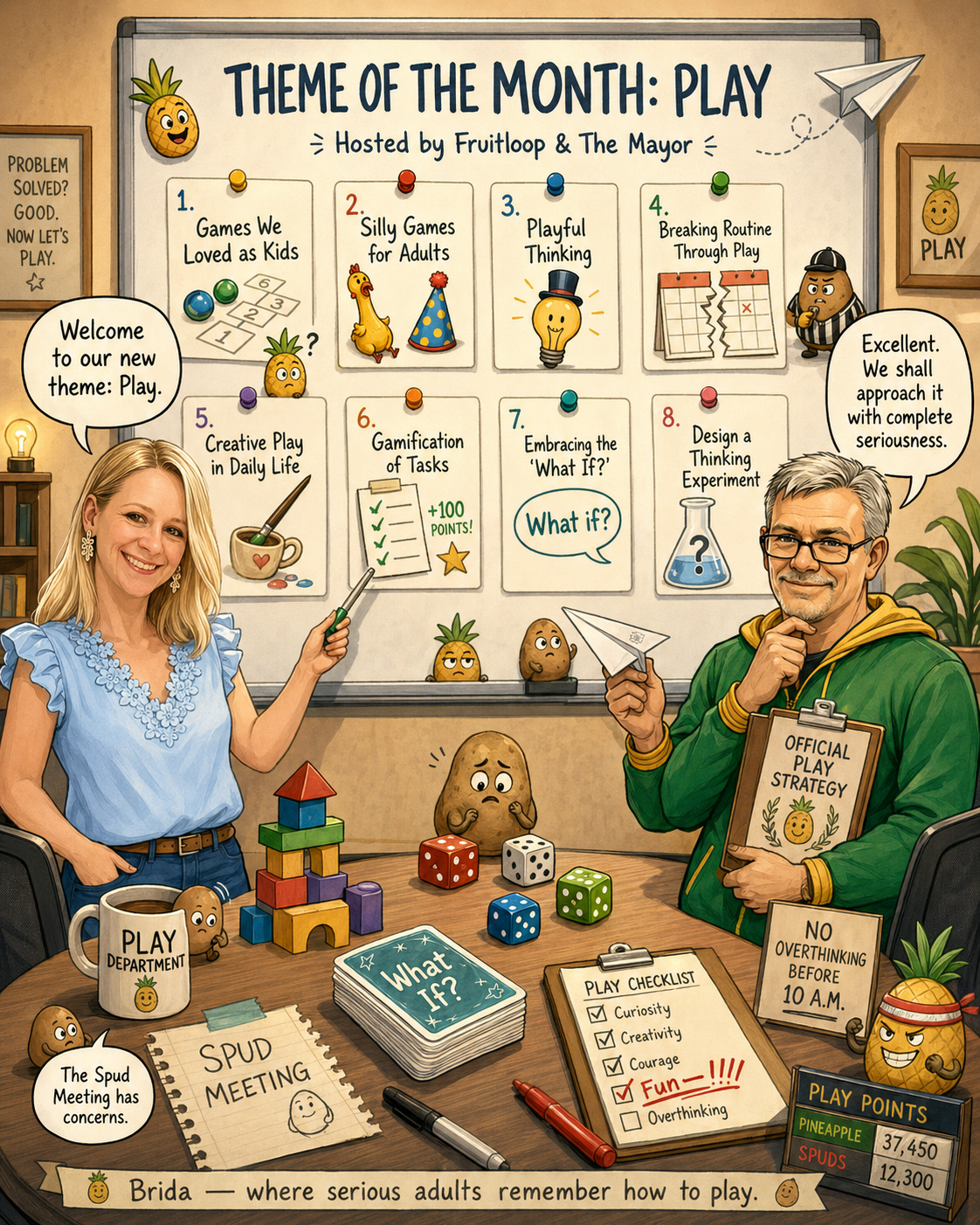
By the end, Rosii had missed the chaos, Natalie was still off-planet with her busy schedule, and Frank and Fruitloop had successfully prepared themselves for next week’s topic: playful thinking. Which, frankly, they had already practised with honours.

The meeting closed not with a grand conclusion, but with dinner advice. Potato peels, it turns out, can be mixed with oil, garlic, herbs, and spices, then thrown into the air fryer until crispy. Future technology may replace jobs, aliens may have magic electricity stones, and dragons may require careful negotiation—but crispy potato peels might still save tomorrow night’s dinner.

And maybe that is the true Lunch philosophy: when the guests don’t arrive, the phone batteries die, the future looks strange, and the aliens are possibly already disguised as doctors, you keep talking. You keep laughing. You keep winging it.

Preferably with snacks.

Partner Page
Advertisement
source
The Pineapple

Peeling Potatoes 45: Marbles, Mud Cakes, and Missing Roots

A Peeling Potatoes reflection on childhood games, memory, and belonging

There are some conversations that begin with a simple topic and then quietly open a door to somewhere much deeper.

This one started with play.

A new month. A new theme. The first of May. International Labour Day, which of course meant that everyone was working hard, because that is how life likes to make jokes at our expense. Fruitloop and the Mayor were live, slightly disorganised, properly caffeinated in spirit if not in fact, and ready to talk about the games they loved to play as children.

At least, Fruitloop was ready.

The Mayor, by his own dramatic admission, had been in a “heightened state of trauma” ever since the topic was chosen. Not because childhood games are frightening in themselves, but because memory is a complicated thing. Some people remember games. Some people remember friends. Some people remember the smell of the garden, the sound of dogs, the colour of the soil, or the way sunlight fell across a courtyard.

And some people remember that they never quite had the rooted childhood that others did.

That was where the conversation slowly went.

It began, as these things often do, with a question.

Fruitloop asked the Mayor what he played as a child. He did what the Mayor does best: he answered the question by walking around it, opening cupboards, checking under the carpet, and eventually finding a story somewhere in Adelaide in the late 1960s.

He remembered West Beach. He remembered a rented house. He remembered an Italian family nearby, the Cusaros, with children he used to visit. He remembered a shaded courtyard with vines overhead, a chicken coop, and children playing marbles.

But the marbles were not really the point.

The point was the atmosphere.

The Mayor admitted that he was probably the worst marble player in history. He was not focused on winning. He was not even especially focused on the rules. What stayed with him was the scene: the courtyard, the shade, the feeling of being there. That is how his childhood memories often work. Not as a list of games played, but as fragments of place, mood, and texture.

Then came the bicycle.

Or rather, the attempt to jump over a bicycle.

There are some childhood ideas that seem perfectly sensible until the moment gravity joins the meeting. The Mayor, not being the most sporting child on the planet, caught his foot on the saddle, tipped over with the bicycle, and went home with half his face transformed into raw flesh. It was, in his telling, a tragic opera of screaming, injury, and maternal clean-up.

Fruitloop, naturally, responded with sympathy.

And then with a correction on facial anatomy.

Because this is Peeling Potatoes, and even childhood trauma must pause occasionally for basic English vocabulary: chin, cheek, eyes, nose, mouth.

From there, somehow, the conversation found its way to “Head, Shoulders, Knees and Toes,” Coco Melon, Zumba coordination, and the possibility that Fruitloop’s struggles with dance movement might have been prevented by more nursery rhyme training in childhood.

This is the beauty of a Peeling Potatoes conversation. One minute you are bleeding from the face in 1960s Australia. The next, you are discussing whether children’s songs are the missing foundation of adult Zumba performance.

But then Fruitloop began to remember.

Her childhood memories felt different immediately. They were not floating fragments. They had roots.

She remembered a house from when she was four or five years old. A big garden. A flower bed. Trees. A huge rock — not a stone, a rock — that came up to her shoulders when she was small. She would climb onto it and play there with dolls.

On the other side of the house were two dogs. In the backyard was a large kidney-shaped swimming pool. Her baby sister would float in the water, wearing a hat, napping in a floaty while Fruitloop played nearby and her mother watched over them.

It was hot. It was summer. It was ordinary. It was magic.

She remembered moving towns. She remembered kindergarten. She remembered meeting her best friend Anja in the sand because a teacher told her, “Play with Anja.” So she did. And just like that, a friendship began.

There were neighbours with a trampoline. Fruitloop and her sister would jump over the wall to use it, and in return the neighbour children would come over to swim. It was a fair trade. Childhood diplomacy at its finest.

There was a treehouse her father built. Sometimes it became a classroom, complete with blackboard, paper, crayons, and books. Fruitloop and her sister would play “school-school,” taking turns as teacher and pupil. One of the books from that time, bought by her grandmother in 1994, still exists. It is taped up now, a little tired, but still intact. Fruitloop is using it today to help her own son read.

There was a treehouse her father built. Sometimes it became a classroom, complete with blackboard, paper, crayons, and books. Fruitloop and her sister would play “school-school,” taking turns as teacher and pupil. One of

That is not just nostalgia. That is continuity.

A book passes from grandmother to granddaughter to great-grandson. A childhood game becomes a real lesson decades later. A pretend classroom becomes part of an actual child’s learning.

Then there were mud cakes.

The treehouse classroom could become a kitchen. Grass, leaves, mud, and whatever else could be found became ingredients. Children are very good at this. Give them very little and they will build a world.

Under the beds, Fruitloop and her sister made Barbie houses. They had Barbie cars, horses, possibly even a boat. They did not have proper Barbie beds, so they made beds out of whatever they could find. Their grandmother bought or made clothes. Another grandmother knitted tiny outfits. Their mother also made dresses.

The Mayor was, naturally, fascinated and mildly jealous.

He imagined having a heart-to-heart with his own mother about why she had not produced more children or knitted dresses for his toys. This is perhaps not a conversation his mother was expecting, but Peeling Potatoes has a way of creating late-life family issues out of nowhere.

Fruitloop’s childhood also had danger, but the good kind. The kind that becomes a story.

There was Park Street, with an uphill climb and four Scottish terriers. The dogs were behind gates, but somehow they got out. Fruitloop and her sister would try to cycle up the street as quietly as possible. If the dogs heard them, they chased.

On one memorable day, Fruitloop’s sister was wearing flip-flops. The dogs came. The girls pedalled for their lives. Her sister lost both shoes and cried at the top of the hill. Fruitloop, being the brave older sister, had to go back and rescue them.

Every childhood needs a dragon. Fruitloop’s dragon was apparently a pack of Scottish terriers.

The Mayor understood the challenge. He has cats, and cats have supernatural hearing. He knows that trying to sneak past an animal is usually an illusion humans tell themselves.

As the conversation moved on, the contrast between Fruitloop and the Mayor became clearer.

Fruitloop’s memories were filled with siblings, neighbours, cousins, school friends, parents, grandparents, pets, gardens, streets, and swimming pools. Her childhood was not perfect, because no childhood is, but it was socially woven. There were people everywhere. There was place everywhere.

The Mayor’s childhood had movement.

Germany. Japan. Australia. Adelaide. Sydney. Saturday German school. British-style private schools. Single-sex schools. Friends who lived too far away to visit easily. Children he saw only when parents arranged it. A local boy across the road because there was nobody else. Cricket games he mostly lost. Batman and Robin games where, of course, he was Robin.

It was not a deprived childhood. In many ways, it was privileged. He saw places. He experienced cultures. He crossed worlds.

But then he said the thing that changed the whole conversation.

When people hear about his childhood, they often say it must have been fantastic. And yes, he said, it was a privilege.

But there was one huge thing missing.

Roots.

Fruitloop knows where she comes from. Her roots are deep. She grew up in places she can still drive past. Her son now attends the same school she attended. She can point to classrooms and remember: this was grade one, this was grade two, this was where we sat, this was where we played.

Her childhood extends into her son’s childhood.

The Mayor does not have that in the same way.

He described himself as a lily floating on a pond, or perhaps a piece of seaweed floating in the ocean, carried by currents. It was funny, because he made it funny. But it was also sad, because the image was true.

That was the emotional heart of the conversation.

The episode was about games, but really it was about belonging.

What does it mean to grow up in one place?
What does it mean to grow up across many places?
What do we gain from movement?
What do we lose when no single place fully claims us?

Fruitloop’s childhood gave her continuity.
The Mayor’s childhood gave him breadth.
Both are gifts.
Both have costs.

The conversation touched, gently, on South Africa too. The Mayor asked about growing up during a time of enormous social change. Fruitloop answered simply and honestly. As a child, she was not focused on politics. Children usually are not. But she remembered that schools were still largely divided. There were only a few black children in her Afrikaans school at the time. Now, her son has black classmates who speak Afrikaans fluently. One of his friends, Langa, went to preschool with him.

It was a small detail, but a powerful one.

History does not only happen in speeches and elections. Sometimes it happens in classrooms, in playgrounds, in the language children speak to each other.

The conversation also returned again and again to the difference between then and now.

When Fruitloop was a child, there was no Netflix, Prime, Disney Plus, or endless screen entertainment. There was no reason to stay inside. Children improvised. They played outside. They made roads in the dirt. They built Barbie houses under beds. They created classrooms in trees. They rode bikes, swam, climbed, ran, invented, and negotiated.

They even, on one unforgettable summer day, used a stranger’s swimming pool.

Fruitloop and the neighbourhood children told one set of parents that the other set knew the pool owners. They told the other set the same thing. In reality, nobody knew the people at all. The children went swimming anyway. They left everything clean and tidy. Nobody chased them away.

It was wrong, of course.

But also, somehow, very childhood.

Today, the world feels different. More watched. More dangerous. More enclosed. Fruitloop’s son still loves playing outside. He drags his trampoline where he wants it. He hates coming in when it gets dark. That is a good sign. But now the trampoline is positioned where she can see him.

Freedom still exists, but it has a longer shadow.

Near the end, the Mayor asked Fruitloop what childhood game she would return to for one afternoon, if she could. Her answer was not the treehouse, or the swimming pool, or Barbie dolls.

She chose the red soil at her grandparents’ place.

She remembered playing with toy cars in the mud with her sister and two cousins. They made roads, water pits, ramps, and little worlds in the dirt. The soil was red and stained everything: shoes, pants, shirts. If she went back, she said, she would wear old clothes.

That image lingers.

Children sitting in red soil, building roads with toy cars.

It is simple. It is beautiful. It is everything.

Then, because Fruitloop is Fruitloop, she asked one final question: if the toy cars suddenly turned into tiny jumping frogs, what would the Mayor do?

The Mayor, who lives in France and has eaten frogs’ legs but does not particularly like them, decided he would not eat the frogs. Instead, he would protect them from his cats and carry them somewhere safe, somewhere with water.

This led to mice, cats, snakes, birds, kittens, and the mysterious “cat distribution system,” by which cats apparently deliver new cats into human lives whether humans are ready or not.

It was a perfectly Peeling Potatoes ending: strange, funny, tender, and somehow exactly right.

Because maybe memory works like that too.

It arrives unexpectedly, carrying something small and vulnerable in its mouth. A marble. A mud cake. A lost flip-flop. A Barbie dress. A Saturday football game. A book from 1994. A red-soil road. A courtyard in Adelaide. A school corridor. A floating baby sister in a swimming pool.

And then we have to decide what to do with it.

Laugh at it.
Protect it.
Tell the story.
Carry it somewhere safe.

This episode was different. Still funny, still wandering, still full of old goats, cats, frogs, and Fruitloop questions. But underneath the playfulness was something tender.

It reminded us that childhood games are never only games.

They are the first places where we learn rules, friendship, risk, imagination, courage, negotiation, defeat, and belonging.

Some children grow up with deep roots.

Some grow up carried by currents.

And sometimes, years later, two friends sit down together, press record, and discover that the games they played were really the maps of who they became.
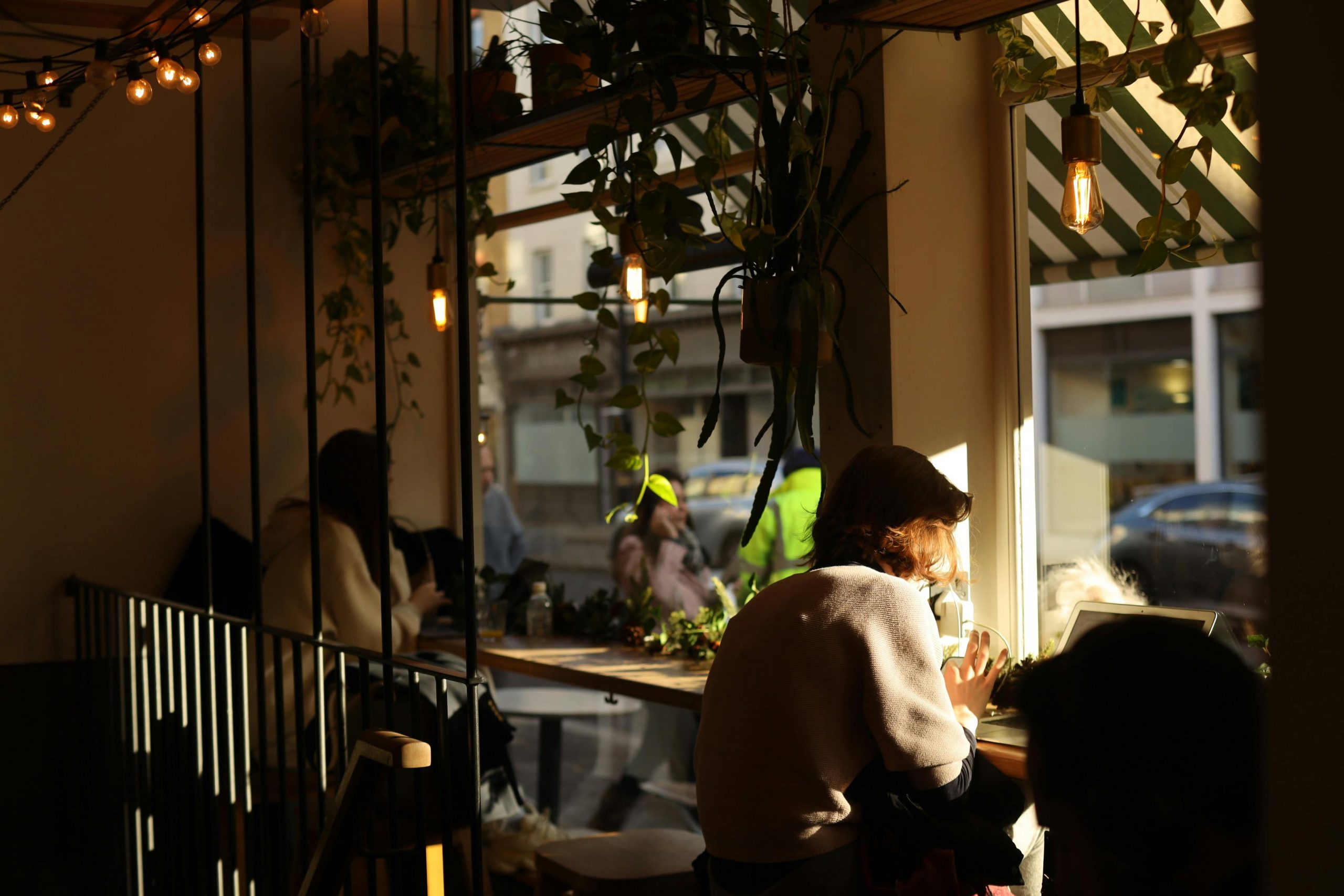
source
The Pineapple

The Potato List and the Storm

Janita wrote this week about our Spud meeting, our potato lists, and the strange little names we give to things behind the scenes.

She is right.

We do name things strangely.

We have Spuds, Pineapples, Peeling Potatoes, cheerios, Fruitloops, tables, chairs, cartoons, conversations, and probably a few other names that would make absolutely no sense to anyone walking into the room halfway through.

But that is what happens when something becomes alive.

It grows its own language.

Every family has this. Every friendship has it. Every little community that has been through a few shared moments eventually starts speaking in words that sound ordinary to outsiders, but carry a whole private history inside them.

For us, a potato list is not just a to-do list.

It is where loose ideas become tasks.
It is where half-mad thoughts are tested.
It is where campaigns begin as crumbs on the table.
It is where we decide what needs watering, what needs peeling, what needs cooking, and what probably needs to be thrown into the compost before it starts smelling funny.

That is the cheerful side of the story.

The Spud meeting.
The funny names.
The little rituals.
The feeling that somewhere behind the scenes, something is quietly being made.

But this week, while Janita was writing about the potatoes, I found myself thinking about the storms.

Because building Brida at the moment does not always feel like sitting in a cosy kitchen with a cup of coffee and a neat list of things to do.

Some days it feels like standing outside in very strange weather, holding a hand-painted sign that says:

Come and talk.

And the wind keeps changing direction.

We have been running campaigns in Serbia and Istanbul. The cartoons travel. People react. Some laugh. Some misunderstand. Some leave comments that make you wonder whether humanity should perhaps take a short rest and try again after lunch.

And some people come closer.

That is the hopeful part.

They see something. They recognise something. They step into our WhatsApp world, curious enough to open the door.

And then, quite often, they pause.

They stand there quietly.

Not because they are stupid. Not because they are uninterested. Not because the idea has failed.

Maybe because the next step is bigger than it looks.

It is one thing to like a cartoon.

It is another thing to enter a conversation.

It is one thing to think, “Yes, this sounds interesting.”

It is another thing to sit at a table, even an online one, with people you do not yet know, and speak in a language that may still feel a little wobbly in your mouth.

It is another thing to sit at a table, even an online one, with people you do not yet know, and speak in a language that may still feel a little wobbly in your mouth.

That is not a small step.

And the world outside is not exactly calm.

Politics is loud. Technology is moving faster than most of us can digest. Work feels uncertain. Attention is scattered. Trust is thin. Everyone seems to be selling something, explaining something, shouting something, predicting something, or warning us that everything we know is about to change by Thursday afternoon.

Into that noise, Brida says something almost ridiculously simple:

Come and talk.

Not study.
Not perform.
Not prove yourself.
Not become a better version of yourself by the end of the week.

Just talk.

It sounds small.

It is not.

Talking is where people become visible. Talking is where confidence begins. Talking is where strangers become less strange. Talking is where English stops being a school subject and becomes a living thing at the table.

A sentence comes out.

Someone listens.

Someone laughs.

Someone says, “I know what you mean.”

And suddenly, something shifts.

Not dramatically. Not with fireworks. Not with the kind of transformation that gets a shiny headline and a suspiciously enthusiastic testimonial.

Quietly.

Humanly.

A little door opens.

This is the part that is difficult to explain in a campaign.

You can make cartoons. You can write posts. You can design banners. You can create invitations. You can polish the words until they shine like apples in a market stall.

But the real thing only happens when people sit down together.

That is where Brida exists.

Not in the slogan.
Not in the flyer.
Not in the WhatsApp link.
Not even in the cartoon.

Those are doors.

Brida is what happens after someone walks through one.

And yes, some days it is incredibly tough.

There are trolls. There are silences. There are promising little sparks that do not immediately become flames. There are people who understand the idea but are not ready to act. There are people who still ask whether we teach English, and then look slightly confused when we say, “Not exactly.”

Because we do not really teach English in the usual sense.

We create a space where English can happen.

Where people can happen.

Where confidence can happen.

Where someone who has spent years thinking, “My English is not good enough,” discovers that maybe the problem was never only grammar. Maybe the problem was the absence of a safe enough place to begin.

That is why the potato lists matter.

They may look small. They may look silly. They may sound like two people giving vegetables more responsibility than vegetables normally deserve.

But they are part of the work.

The work is not only the conversation at the table. It is also everything that makes the table possible.

The planning.
The invitations.
The topics.
The cartoons.
The reminders.
The awkward experiments.
The campaigns that almost work.
The campaigns that teach us where people hesitate.
The quiet adjustments after the noise has passed.

A Brida table does not simply appear.

It is set.

Again and again.

Sometimes with confidence. Sometimes with doubt. Sometimes with a list of potatoes and a face that says, “Well, let’s try this and see if anyone comes in from the storm.”

That may not sound like magic.

But perhaps real magic rarely does.

Perhaps real magic is not the grand moment when everything suddenly works.

Perhaps it is the stubborn little rhythm of showing up.

Making the list.
Sending the invitation.
Drawing the cartoon.
Opening the room.
Welcoming the person who arrives nervous.
Listening when they speak.
Remembering their story.
Trying again next week.

So yes, we have our Spud meetings.

We have our potato lists.

We have our odd names, our Pineapples, our Peeling Potatoes, our cheerful refusal to become cheerios.

But underneath all that playfulness is something serious.

We believe talking is not small.

We believe people need places where they can be heard without having to perform.

We believe English becomes more useful, more natural, and more alive when it is connected to real people and real stories.

We believe that even in a noisy world, especially in a noisy world, a small table can matter.

And that is why we keep going.

One potato list at a time.

Partner Page
Advertisement