Brida

Brida

THE EUROPEAN CONVERSATION PROJECT

Different worlds.
The same human questions.

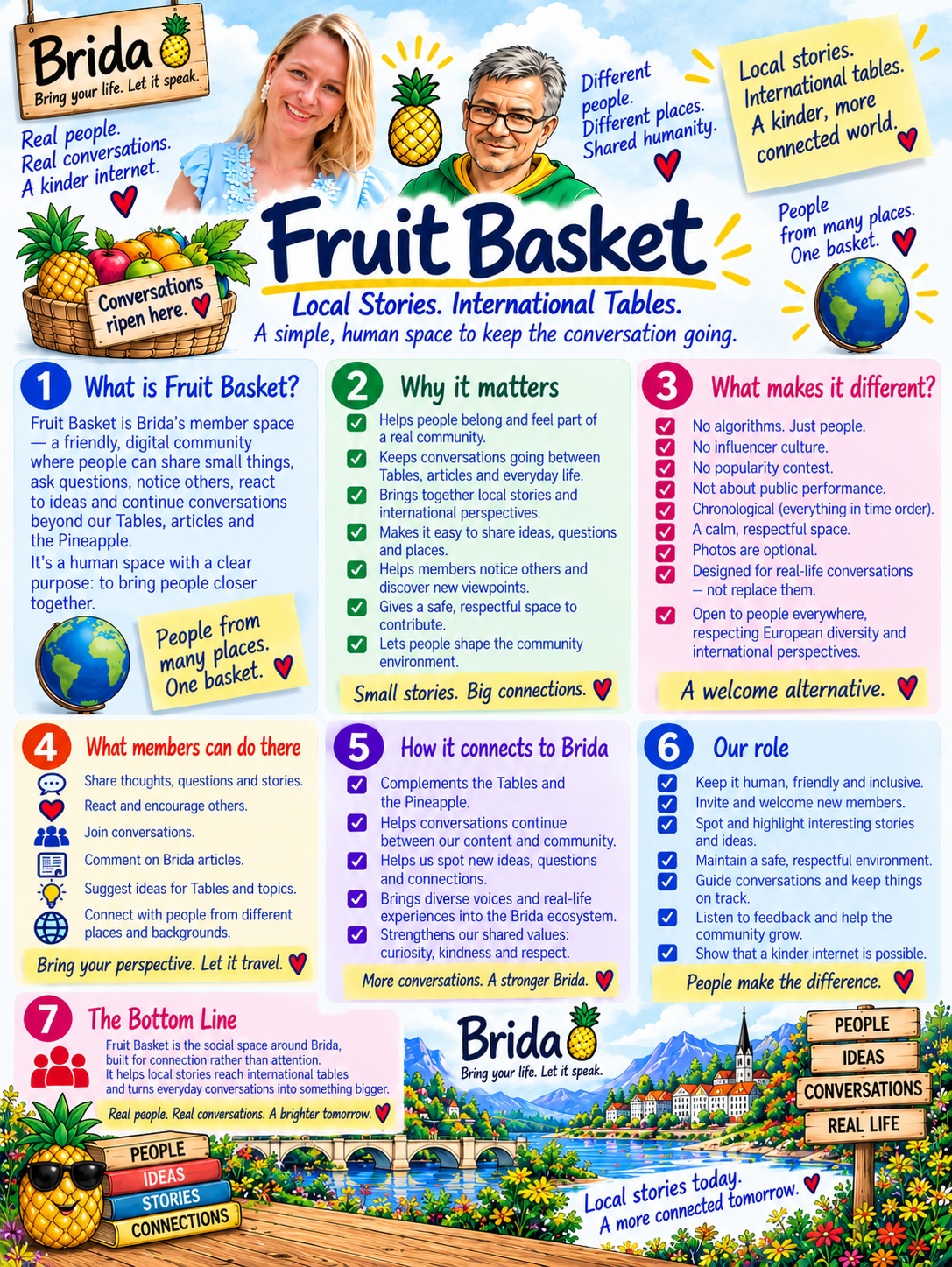
Brida brings non-native speakers of English together for conversations that would probably never happen otherwise.

Online · In English · Hosted by real people

Across Europe Looking widely Curating carefully The point is not scale. It is finding the right mix for a conversation worth having.

We started with English.

Then technology changed what people could do with language.

Brida began by helping adults become more confident using English.

As AI became remarkably good at translating, correcting, explaining and producing language, we could have defended the old model.

Instead, we became curious about what still mattered.

People still needed other people.

They still needed somewhere to speak, listen, compare experience, disagree, recognise themselves in somebody else and sometimes meet a person they would never normally encounter.

So Brida evolved.

We used to help people improve their English. Now we also use English to help people encounter one another.
Frank Peters and Janita Le Grange, the people behind Brida

THE PEOPLE BEHIND BRIDA

Brida is deliberately small.

Frank Peters works from France, developing the European Conversation Project, curating and hosting conversations, and following interesting work across Europe.

Janita Le Grange works from South Africa, hosting conversations and shaping The Pineapple — listening for what is worth carrying further.

Brida began with adult English learning. Over time, the most valuable part became clearer: not the language on its own, but what happens when people with different experiences sit down and really talk.

Today, we still use English. But increasingly, we use it to help people encounter one another.

Frank PetersFounder & Host · France
Janita Le GrangeEditor & Host · South Africa

The people you see here are the people doing the work.

TWO KINDS OF TABLE

Same Brida. Different reasons to sit down.

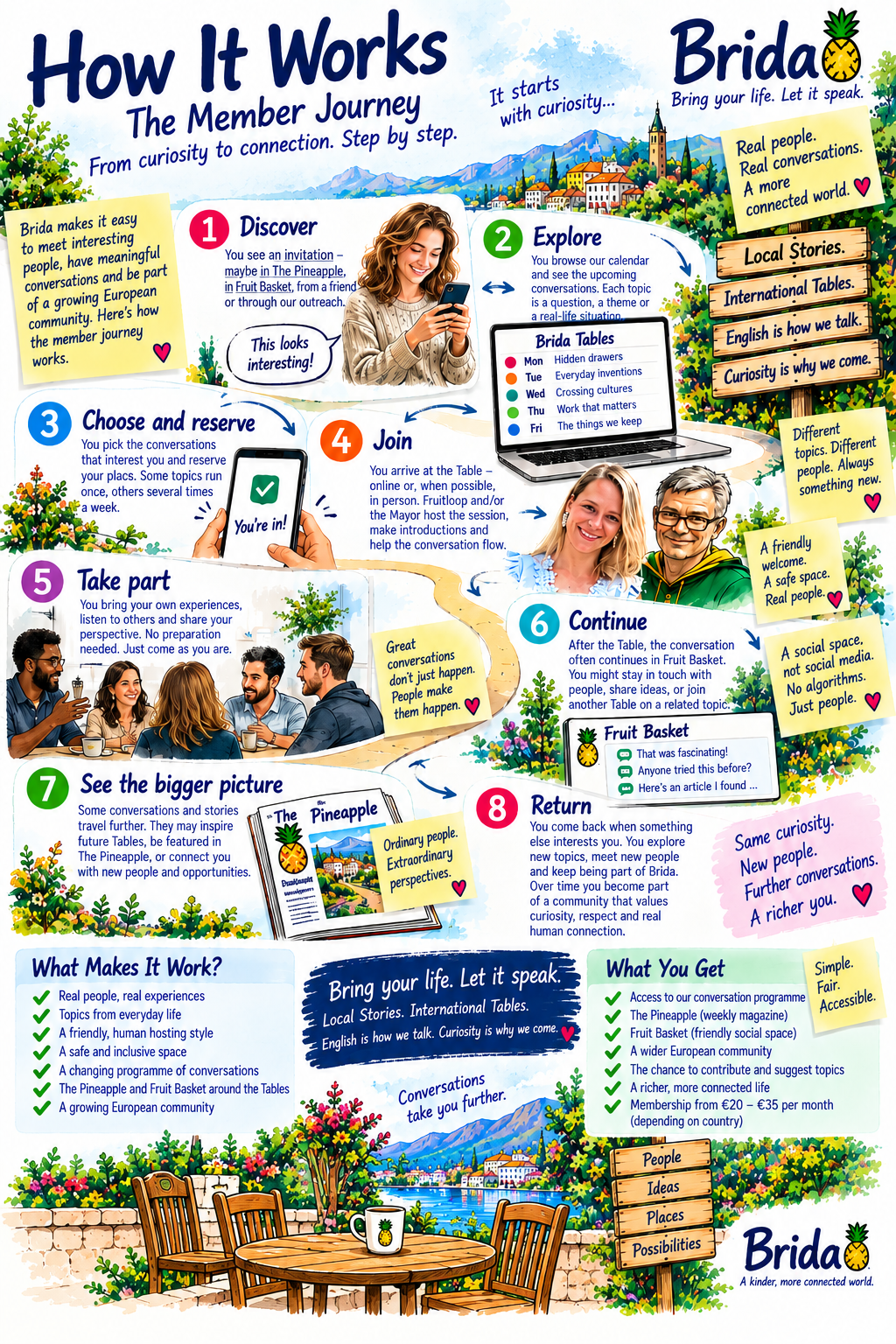
Pineapple Tables begin with a particular question and a deliberately chosen mix of people. There is no membership: you come when a conversation catches your attention, and you can return whenever another one does. Brida Tables give private individuals a regular monthly rhythm for using their English in real conversation.

01 Curated conversation

Pineapple Tables

Five people from different worlds. One question they have all lived in their own way.

We deliberately bring together people whose work or lives may look unrelated, but who recognise something underneath the surface. You may come once, or you may find yourself returning whenever another question catches you.

A good Pineapple Table should create more than the hour itself: another question, another person, another conversation, a Tuber, an interview, or something that eventually finds its way into The Pineapple.

  • Small, deliberately curated groups
  • About 60 minutes online
  • English is the shared medium
  • No presentation and no need to represent your organisation
  • Experience in the room can help somebody notice what may be coming next
02 Monthly membership

Brida Tables

One month. Usually four or five weekly chairs. One small international table.

You join a small table for the month and meet once a week. The subject changes across the month; the people have time to become familiar. Next month brings a new conversation territory and Brida may gently remix the tables.

  • One hosted chair each week — normally four or five per month
  • Usually five or six people and a host
  • English is the shared language, not the lesson
  • Playful doorways, real stories and room to go deeper
  • €80 standard monthly rate, with regional access rates — all charged in EUR

A NOTE ABOUT TRANSCRIPTION

So we can listen properly, we do not rely on memory alone.

Brida Tables and Pineapple Tables are automatically transcribed on Zoom. We use the transcript as a temporary working record so we can follow the conversation accurately and develop what may come from it. Working transcripts and summaries are normally deleted after 30 days.

Taking part does not mean agreeing to appear in The Pineapple. Publication is a separate editorial step.

If you have any concerns about transcription or how your contribution may be used, tell us before the Table.

THE PROGRAMME

A Year in Motion.

A course without the course. Every month gives the table a fresh territory and eight possible doorways. The host chooses what fits the people in the room. We start lightly, follow real experience and let depth earn its way in.

Light but deepEasy to enter. No compulsory vulnerability.
Lived, not taughtStories and observations before advice or lessons.
Local stays localInternational Tables. Local Stories. Difference is welcome.
Notice what is movingWhat is appearing, disappearing, changing or quietly catching on?
SEPTEMBER — DECEMBER 2026

Four months to begin.

Playful subjects. Ordinary life. Plenty of room for the conversation to surprise us.

SeptemberEveryday Mysteries

Ordinary life contains an extraordinary number of things nobody has ever properly explained. We look at the familiar until it becomes slightly unfamiliar.

  1. The Drawer Everyone Has
  2. The Button Nobody Presses
  3. Household Rules We Thought Were Normal
  4. The Great Queue Mystery
  5. Objects Nobody Knows How to Throw Away
  6. Everyday Inventions That Deserve Applause
  7. Habits That Make No Logical Sense
  8. Things That Seem Obvious — Until Someone Asks Why
OctoberUnwritten Rules

Nobody gave us the handbook, yet somehow we are all expected to know. The answers depend enormously on where we live, where we work and who taught us the rules.

  1. Who Goes First?
  2. How Late Is Late?
  3. The Correct Distance Between Strangers
  4. Who Pays?
  5. When Should a Guest Leave?
  6. Workplace Rules Nobody Explains
  7. What Counts as Polite?
  8. When Breaking the Rule Improved Everything
NovemberSmall Delights

Not everything worth talking about has to be important. This month is about the small things that improve an ordinary day.

  1. The Sound That Improves a Day
  2. Food That Tastes Better Than It Should
  3. Tiny Luxuries
  4. Things That Get Better in Winter
  5. The Pleasure of Cancelled Plans
  6. Places That Change the Mood
  7. Objects That Are Satisfying to Use
  8. The Ordinary Moment Worth Protecting
DecemberThings That Should Not Work Together

Some of the best combinations look wrong on paper. Old and new. Serious and silly. An idea borrowed from one world and used somewhere completely different.

  1. Food Combinations People Swear By
  2. The Odd Couple
  3. Old Meets New
  4. Serious Work Helped by Something Silly
  5. Borrowed Traditions
  6. Styles That Should Clash — But Do Not
  7. Ideas From One World Solving Another
  8. The Combination That Changed Everything
BRIDA 2027

International Tables. Local Stories.

The same year looks different depending on where you are. We keep the local texture intact and let people compare, laugh, question and notice what is changing.

JanuaryStarting Again, More or Less

January arrives with enormous expectations for a month that is often mostly about finding the correct drawer again. We begin with restarts: successful ones, reluctant ones and those that lasted until the second Tuesday.

  1. The Thing I Keep Starting Again
  2. The January Rule I Never Follow
  3. A Small Brave Thing I Nearly Did Not Do
  4. Old Habits With Excellent Survival Skills
  5. When Starting Again Was Harder Than Expected
  6. The First Week Back at Work
  7. What January Looks Like Where I Live
  8. Something I Want to Try Differently This Time
FebruaryThe People Around Us

Neighbours. Colleagues. Old friends. New friends. The person behind the counter. This month is about the people who quietly shape ordinary life.

  1. The Neighbour Everyone Knows
  2. Someone I See All the Time but Barely Know
  3. Old Friends, New Versions
  4. The Colleague Who Makes Work Better
  5. People Who Are Very Different in Another Language
  6. When Someone Unexpectedly Helped
  7. Who Do People Actually Talk To Where You Live?
  8. A Kind of Relationship That Seems to Be Changing
MarchPlans Have Other Ideas

Plans are wonderfully confident until they encounter reality. Trains disappear. Projects change. People say no. Weather intervenes. Somebody has a better idea. March belongs to Plan B.

  1. The Plan That Did Not Survive Contact With Life
  2. A Detour That Turned Out Well
  3. The Day Everything Ran Late
  4. A Mistake That Opened Another Door
  5. The Workaround Everybody Now Uses
  6. When Standing Still Was Actually Progress
  7. How Do People Handle Changed Plans Where You Are?
  8. Something That Seems Less Predictable Than It Used To
AprilTry It and See

Not every idea needs a five-year strategy. Sometimes somebody simply says: shall we try it? April is for experiments, first attempts, questionable prototypes and things people are beginning to do differently.

  1. The Thing I Tried Without Being Ready
  2. A First Version That Was Terrible
  3. Something We Tried at Work
  4. An Experiment That Became a Habit
  5. A Failure That Was Surprisingly Useful
  6. Something New People Are Trying Where I Live
  7. An Old Idea That Might Be Useful Again
  8. Something I Have Seen Recently and Thought: That Might Catch On
MayThings People Do Not Say

Every place has things everybody understands without anybody saying them aloud. At work. At home. Among friends. Between strangers.

  1. The Sentence Nobody Wanted to Say
  2. What Politeness Sometimes Hides
  3. The Workplace Rule Nobody Explains
  4. When Humour Said It Better
  5. Something Easier to Say in Another Language
  6. When Silence Became Awkward
  7. What Counts as Direct Where You Live?
  8. Something People Seem More Willing to Talk About Now
JuneFollowing the Thread

One question leads to another. Then somebody mentions something nobody else has heard of. Twenty minutes later the whole table has disappeared down a completely unexpected rabbit hole. Excellent.

  1. The Question That Would Not Leave Me Alone
  2. A Small Interest That Became Much Bigger
  3. The Thing I Looked Up and Never Escaped
  4. Someone Else’s World I Became Curious About
  5. A Question Nobody Asked at Work
  6. Something I Recently Discovered by Accident
  7. What Are People Curious About Where You Are?
  8. A Thread I Think Is Worth Following Next
JulyThe Slightly Different Route

Adventure does not require an airport. Sometimes it is another street, another cafe, a strange invitation or finally entering the building you have walked past for ten years.

  1. The Day I Went a Different Way
  2. A Local Place I Should Have Noticed Earlier
  3. The Invitation I Nearly Refused
  4. Doing Something Alone for the First Time
  5. A Place That Changed My Mood
  6. When Unfamiliar Became Friendly
  7. Where Do People Go Locally That Visitors Never See?
  8. Something About My Area That Is Changing
AugustHome Is a Funny Thing

Home can be an address, a smell, a language, a room, a person or the place where you know which cupboard contains the glasses.

  1. The Thing That Makes a Place Feel Like Home
  2. The Household Rule I Thought Everyone Had
  3. The Food That Means Home
  4. When Being a Guest Felt Strange
  5. What Visitors Never Understand at First
  6. Something I Brought Home From Somewhere Else
  7. A Local Tradition I Would Miss
  8. What Is Changing About Home Where You Live?
SeptemberNormal Here, Strange There

Everywhere has things people regard as entirely normal — until somebody from somewhere else arrives. No need to decide whose way is better. “Really? You do that?” is enough.

  1. The Thing We Do That Visitors Find Strange
  2. How Late Is Late Here?
  3. A Food People Elsewhere Do Not Understand
  4. The Local Rule Nobody Questions
  5. Something That Surprised Me Somewhere Else
  6. The Work Habit I Assumed Was Universal
  7. Something That Is Normal Here but Changing Fast
  8. What Might Become Normal Next?
OctoberWho Decided That?

A surprising amount of life consists of rules nobody remembers creating. October gives ordinary systems a gentle poke.

  1. A Rule Nobody Remembers Starting
  2. The System That Makes No Sense
  3. Who Goes First?
  4. Something Everyone Does Because Everyone Does It
  5. The Tradition Nobody Wants to Change
  6. A Workplace Habit That Has Outlived Its Purpose
  7. A Rule People Are Quietly Ignoring
  8. Something We May Eventually Wonder Why We Ever Did
NovemberSmall Things That Work

Grand solutions get plenty of attention. November belongs to the little ones: objects, routines, shortcuts, designs, habits and local ideas that simply make life work better.

  1. An Everyday Invention That Deserves Applause
  2. The Object I Enjoy Using
  3. A Tiny Shortcut That Actually Helps
  4. Something My Town Gets Right
  5. A Simple Idea From Work
  6. An Old Solution That Still Works Perfectly
  7. Something Clever I Saw Somewhere Else
  8. A Small Idea I Think More People Will Copy
DecemberThings That Should Not Work — But Do

We finish the year with unlikely combinations. Different people. Different traditions. Different generations. Old tools with new technology. Sometimes the interesting bit is precisely the mismatch.

  1. The Odd Couple
  2. A Food Combination I Will Defend
  3. Old Meets New
  4. Serious Work Helped by Something Silly
  5. A Tradition Borrowed From Somewhere Else
  6. Two Styles That Somehow Work Together
  7. An Idea From One World Solving a Problem in Another
  8. Something Unexpected I Want to Take Into Next Year

BRIDA TABLE MEMBERSHIP

Find your table.

One month is the doorway. A whole year is there if you want it.

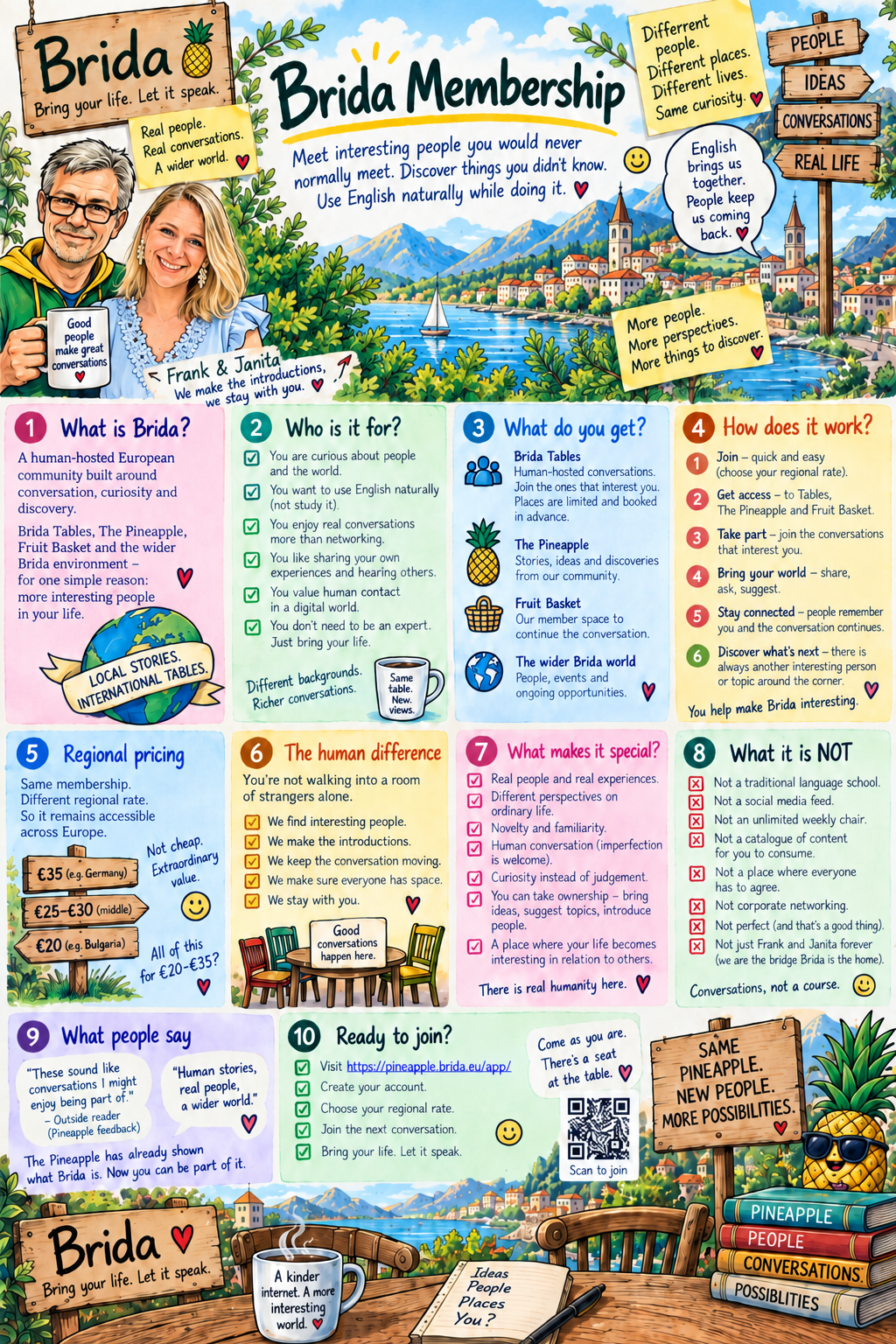
Membership is a monthly flat-rate programme built around one chair each week — normally four or five chairs depending on how the weekdays fall. You stay with the same small table for that month, so week two is not another room full of strangers. The next month brings a new territory and, where useful, a new mix of people.

The rhythm is European rather than tied to every national holiday calendar. Some months are naturally quieter around public holidays, Christmas/New Year or Easter; the monthly price stays the same throughout the year.

No lessons. No levels. No homework. No graduation. Just a regular place to use your English with real people and keep meeting lives beyond your usual circle.

HOW MUCH DOES IT COST?

€80 standard. Regional access rates.

The standard Brida Table rate is €80 per person per month. To keep the monthly commitment achievable across Europe, selected countries use access rates of €70, €60, €50 or €45. Choose your country of residence to see the rate that applies.

All prices are set and charged in euros (EUR). If your PayPal account or payment method uses another currency, your payment provider will show the converted amount before you confirm payment. Its exchange rate and any conversion charge are set by the provider, not by Brida.

Choose your country to see your Brida price.
No payment is taken here. Your table, normal weekly time and monthly price are confirmed first. Brida Table subscriptions are then paid monthly through PayPal and renew automatically until cancelled.

Brida uses these details to respond to your request, work out a suitable Table and contact you about it. This form does not subscribe you to The Pineapple or any mailing list. Privacy details.

PINEAPPLE TABLES · HOW THE CURATION WORKS

Different worlds.
Something in common.

A Pineapple Table does not begin with an industry. It begins with people whose work may look completely different, but whose experience contains a recognisable common denominator.

Someone may work in manufacturing. Someone else in research, food, technology, craft, care or culture. They may live in different countries and work for organisations that appear to have almost nothing in common.

But underneath the job titles, there is often a tension, decision or experience they have all met in different ways.

The point is not random diversity. The difference has to be useful.
01Different peopleDifferent roles and lived experience.
02Different organisationsNo sector networking bubble.
03Different countriesWithout asking anyone to represent a nation.
04One common denominatorA tension they recognise in different forms.
05One question worth exploringThat is where the Table begins.

WHO MIGHT BE AROUND THE TABLE?

You do not have to be the person at the top.

One of the clearest things we found while looking across Europe is that the most interesting person in an organisation is not always the founder, director or person whose name appears first on the website.

Close to reality

Production, installation, testing, maintenance, field support or delivery.

Between product and user

Applications, after-sales, support, project delivery and customer-facing technical work.

Carrying tacit knowledge

Years of judgement that procedures and manuals never quite capture.

Meeting failure early

Quality, reliability, safety, troubleshooting, testing and repair.

Where research becomes consequence

Scale-up, production, living systems, real users and deployment.

Making with hands, eyes or taste

Craft, food, materials, machinery, repair and specialist practice.

A QUESTION WORTH EXPLORING WITH SOMEONE UNLIKE YOU

The value is not that everybody answers the same question. It is that somebody else's experience may change how you see what comes next.

01

What did the real work teach you that the original plan did not?

A production manager, scientist, installer, craftsperson and founder may all have discovered that reality has opinions of its own.

02

What do you know now that would be very difficult to teach from a book?

Years of practice can produce judgement that procedures, qualifications and manuals never quite capture.

03

What do customers or users do that the people who built the product never expected?

Sometimes the most useful information appears only after an idea leaves the organisation and meets another human being.

04

What kind of failure teaches you something that success cannot?

Testing, quality, repair, research and real-world deployment often turn failure into evidence.

05

How much evidence is enough before you act?

The consequences may be completely different, but many people know the uncomfortable point where waiting is also a decision.

06

How do you change something without losing what matters?

A family business, factory, craft tradition and technology company can all recognise that problem for very different reasons.

WHAT MIGHT YOU GET FROM IT?

Not five answers.
Five perspectives on something you recognise.

You probably do not need another person from your own industry telling you what your industry already knows.

Somebody whose work appears completely unrelated to yours may have lived another version of the problem you are facing.

A useful comparisonHow did somebody else meet the same tension under completely different constraints?
A different questionYou may leave thinking about the problem differently rather than carrying away a ready-made answer.
An earlier warningSomebody else may already have lived through a situation you are only beginning to encounter.
Language for something familiarAnother person may put words around something you have understood instinctively for years.
A view from outside your worldSomeone who knows nothing about your sector may notice the assumption everybody inside it stopped noticing.
Or you may simply realise: “So it isn't only us.”

WHAT ARE YOU NOTICING?

The future often arrives quietly.

A Pineapple Table may begin with something that has already happened. Then somebody says, “That is starting here too,” or “We have been doing that for years.” That is where the conversation becomes useful: not prediction, just people noticing change from where they actually are.

Something appearingA new habit, tool, expectation or way of working that has quietly entered ordinary life.
Something disappearingA practice people have stopped doing before anyone officially announced its end.
Something travellingAn idea that is ordinary in one place and still surprising somewhere else.
Something worth watchingNo forecast required. Curiosity is enough.
Sometimes the most interesting sentence at the Table is simply: “Really? That is already happening there?”

CONVERSATIONS FORMING

When a question and the right people begin to meet.

This section is ready to receive public FORMING Tables from Brida's Table Builder. Until a Table is deliberately made public, nothing is invented here.

The first public Tables are being curated.

If one of the questions above catches your attention, raise your hand. Interest does not guarantee a chair; it gives Brida another human to consider when a Table takes shape.

Tell us what caught your attention ↓

RECOGNISE YOURSELF SOMEWHERE HERE?

Raise your hand.

You do not have to book anything. Tell us which question connects with your experience and, if it looks as though there may be a useful Table around it, Brida can get in touch.

A Pineapple Table remains curated. Expressing interest does not automatically reserve a chair.

Bring what you have learned. We will look for people whose experience may help you see what comes next differently.

Brida uses these details to respond to this expression of interest and, where relevant, contact you about a Table around it. This form does not subscribe you to The Pineapple or any mailing list. Privacy details.

WE WENT LOOKING ACROSS EUROPE

Europe gets interesting when the right people sit down to talk.

A good conversation is rarely about putting the most important people in the room. It is about the mix.

Someone who has seen a problem from the other side. Someone who has already lived through what another person is only beginning to face. Someone from a different city, profession or working culture who notices something your own world might miss.

That is how we have been looking across Europe. We have explored many organisations, followed interesting work and come across people close to what is actually happening — founders, makers, operators, researchers, specialists and others with something real to bring.

Then comes the part that matters: who might have a genuinely worthwhile conversation together?

A wide European viewMany organisations, many cities and very different working worlds.
People with something to bringNot necessarily the most senior or the most visible. Often the people closest to the real work.
The right mixWe bring people together where different experiences might make the conversation more useful, surprising or illuminating.
01

What happens when reality refuses the plan?

02

What should remain human when more can be automated?

03

What do experienced people know that cannot quite be written down?

04

How much evidence is enough before you act?

05

How do you change without losing what matters?

06

How do you know when to keep going — and when to stop?

Different professions are not the point. Useful difference is.

Why me?

Because you may have something genuinely valuable to bring.

A Pineapple Table is built around the mix of people in the conversation.

You may have lived through something another person is only beginning to face. You may see a familiar problem from a completely different angle. You may know something from experience that rarely makes it into reports, presentations or job titles.

That experience may be useful to somebody else around the table.

And theirs may be useful to you.

We are not looking for the most senior person in the organisation, the biggest name or the polished expert answer. We are interested in people whose experience can make a conversation richer — and who may find something useful in hearing how others have approached a different version of the same human question.

If our paths cross, it may be because something in your experience could matter to somebody else around the table.

WHAT A TABLE FEELS LIKE

No performance required.

01Small

Usually five or six people and a host. Enough difference for surprise, small enough for an actual conversation.

02Hosted

Frank in France or Janita in South Africa holds the room, the question and the rhythm.

03Human

No slides. No panel. No requirement to sound clever. Bring what you have actually lived.

04In English

English gives us a shared table. It does not require everybody to sound like a native speaker.

Conversation comes first. Publication is separate.

THE PINEAPPLE

The conversation does not stop at the table.

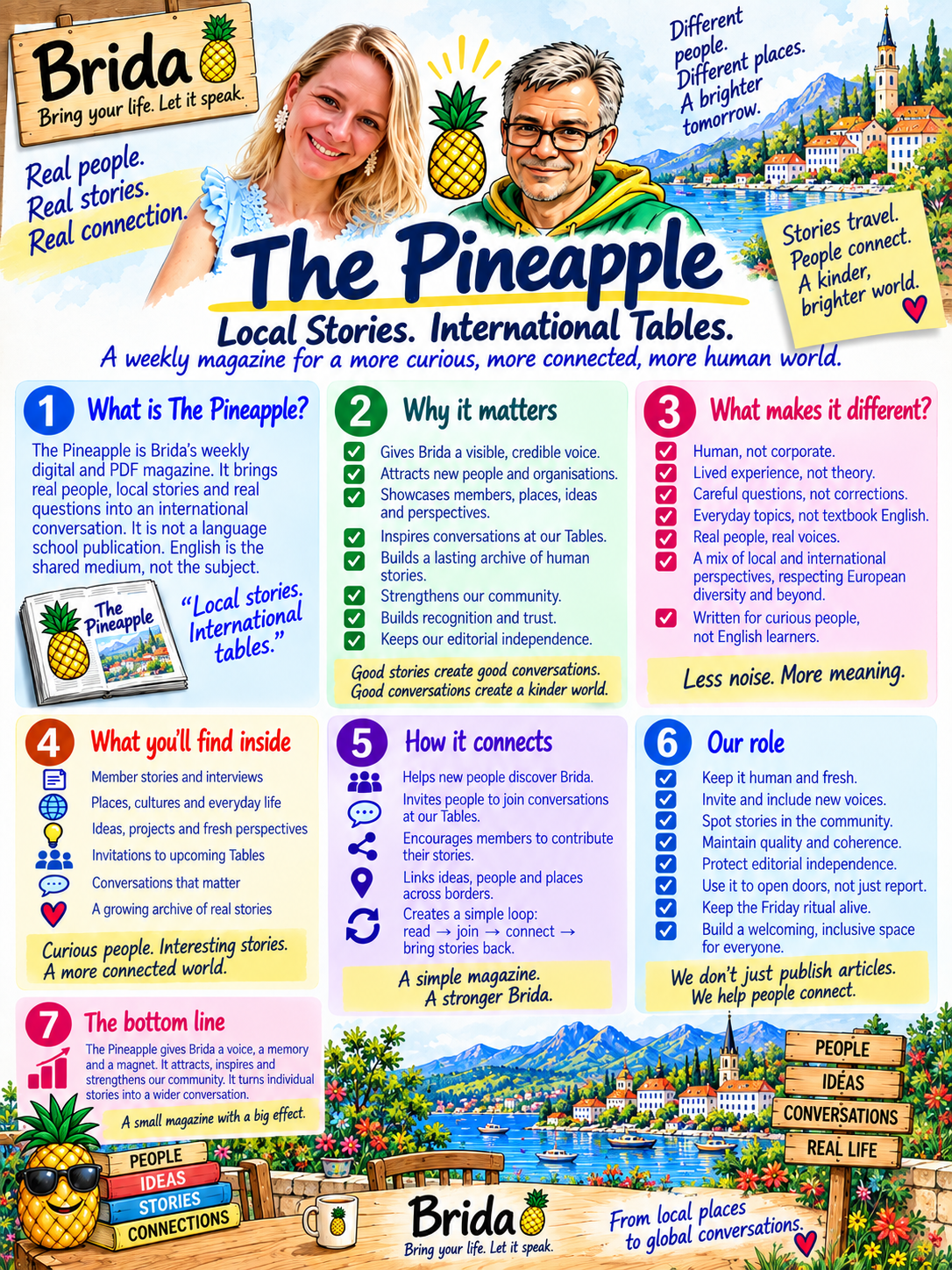
A lot of Brida's table life flows into The Pineapple — not as transcripts, but as questions, observations, interviews, local stories, cartoons and the unexpected things that become visible when different people meet.

A Brida Table may spark a question worth following. A Pineapple story may send a new question back to the tables. A small local detail may turn out to travel surprisingly well.

The 2026 and 2027 programmes give The Pineapple a living current through the year: playful subjects on the surface, human experience underneath, and plenty of room to notice what is changing.

Conversation comes first. Publication is always a separate editorial decision.

Curious.
Unexpected.
Human.

The website can tell you what Brida is trying to do. The Pineapple shows what can grow from the questions, people and stories around the tables.

International Tables. Local Stories. Publicly, only when it belongs there.
Current issue Open in full ↗

Same month.
Very different lives.

A question about guests sounds different in Greece, Denmark, Poland or South Africa. A work habit that feels new in one place may already be ordinary somewhere else.

That is the advantage of an international table: not grand statements about the world, but real people telling you how it looks from where they are.

Sometimes the surprise is cultural. Sometimes practical. Sometimes funny. Sometimes somebody quietly says, “That is starting to happen here too.”

That is enough future thinking for us: noticing what is moving while it is still human-sized.

A FEW STRAIGHT ANSWERS

Before you ask.

Is a Brida Table an English course?

No. There are no lessons, levels, homework or tests. You use English because it gives the table a shared language. The practice happens inside the conversation.

How does Brida Table membership work?

You join month to month. Your flat-rate membership gives you one weekly chair, normally four or five chairs in a calendar month. It renews automatically through PayPal until you cancel; cancellation stops the next renewal and takes effect at the end of your current paid month.

Do I have to join for a year?

No. One month is the doorway. A Year in Motion is designed to keep changing across the year, so there is a reason to stay if the conversations keep taking you somewhere interesting.

How much does Brida membership cost?

The standard rate is €80 per month, with regional access rates of €70, €60, €50 or €45 in selected countries. Choose your country of residence in the membership section to see the rate that applies before you join. Payment is monthly through PayPal and renews automatically until you cancel future renewal.

What happens in months with public holidays?

Brida Tables are a flat-rate European programme, not a per-session package. Most months provide four or five weekly chairs, but public holidays, Christmas/New Year and Easter can make some periods quieter. Brida follows its own published operating calendar rather than every country's holiday calendar, and the monthly price stays the same.

Do I need perfect English?

No. You need enough English to take part in a real conversation and the willingness to keep going when a sentence is not perfect.

Why so many local questions?

Because international conversation becomes interesting when local identity stays intact. Nobody has to represent a country. Just tell us how it works where you are.

Is a Pineapple Table networking?

No. There is no pitch round and no promise of leads. We curate people because their different experiences may illuminate the same human question. There is no membership either: come when a Table catches your attention, and return when another one does.

Are Tables transcribed?

Yes. Brida Tables and Pineapple Tables use Zoom's automatic transcription so the hosts can follow the conversation accurately without relying on memory alone. Participants are told before taking part. Working transcripts and summaries are normally deleted after 30 days.

Will what I say be published?

No. Taking part in a transcribed Table does not mean agreeing to appear in The Pineapple. Publication is a separate editorial decision, and Brida keeps editorial responsibility for what is ultimately published.

How much is a Pineapple Table?

A Pineapple Table chair is €50 for one specific curated conversation. There is no membership and no automatic renewal. Brida confirms your chair first and then sends an invoice, due within 7 days of confirmation (or before the Table if it takes place sooner).

INTERNATIONAL TABLES. LOCAL STORIES.

Bring something from where you are.

A story. A question. Something funny, useful, odd or changing. Then hear what comes back from around the table.

Frank · France    /    Janita · South Africa